

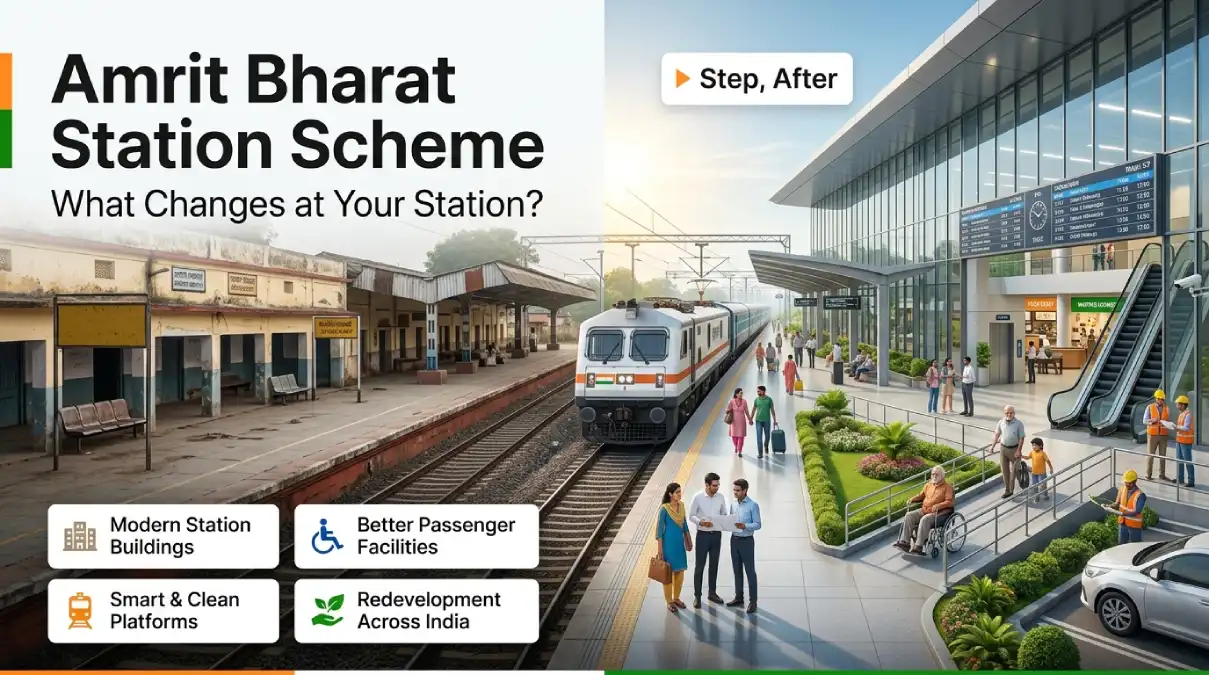
The Amrit Bharat Station Scheme is Indian Railways program to rebuild more than 1,300 railway stations across the country. Launched in December 2022, it covers everything from the station building and platforms to lifts, waiting areas, parking and connectivity with the city around it. This guide explains what the scheme does, what actually changes at a redeveloped station, how far it has progressed, and how to check whether your station is included.
Not to be confused with the Amrit Bharat Express. The Amrit Bharat Station Scheme is about redeveloping stations. The Amrit Bharat Express is a train, a non-AC superfast service with push-pull operation. They share a name but are entirely separate.
🚆 Quick Information
| Scheme name | Amrit Bharat Station Scheme (ABSS) |
| Launched | December 2022, by the Ministry of Railways |
| Stations identified | More than 1,300 across the country |
| In aspirational districts | Around 157 stations |
| Approach | Long-term master planning, executed in phases |
| First batch opened | 103 stations, May 2025 |
| Second batch opened | 75 stations, July 2026 |
What the Scheme Actually Does
Earlier station upgrade programmes largely added facilities to existing buildings. This one works differently. Each station gets a master plan setting out how it should look and function over the long term, and the work is then carried out in stages according to what that station needs and what funding allows.
The thinking behind it is that a station should function as more than a place to catch a train. The scheme treats it as a city centre, connecting both sides of the town, linking to buses and metro, and serving people who live around it as well as those travelling.
What Changes at a Redeveloped Station
The Building and Approach
- A redesigned façade and entrance porch, usually drawing on local architecture.
- Wider circulating areas so crowds do not bottleneck at the entrance.
- Improved roads, parking and drop-off arrangements outside.
- Landscaping and open space around the building.
Inside the Station
- Modern waiting halls, often separated by class of travel.
- Executive lounges at larger stations.
- Upgraded toilets, one of the most common passenger complaints addressed.
- Lifts and escalators, which matter enormously for older people and anyone with luggage.
- Better passenger information systems and display boards.
- Free Wi-Fi.
- Food courts, kiosks and in some cases a children’s play area.
Platforms and Movement
- Resurfaced platforms and improved shelters.
- Wide foot overbridges and, at some stations, a roof plaza spanning the tracks.
- Underpasses where they suit the layout better.
- Ballastless track in station areas where feasible, which reduces noise and maintenance.
Accessibility for Divyangjan
Accessibility runs through the design rather than being added afterwards. Redeveloped stations include ramps, lifts, accessible toilets, tactile paths and signage designed for passengers with disabilities.
This matters practically. A station with working lifts and a level route from entrance to platform is usable independently, whereas one with only a steep foot overbridge is not. For assistance services available alongside, see our guides on Yatri Mitra Sewa and wheelchair services at stations.
Designs Drawn from Local Heritage
One deliberate feature is that redeveloped stations are not built to a single template. Designs take cues from the culture, heritage and architecture of the place, with local temples, forts and heritage buildings used as themes.
The intent is that arriving at a station tells you something about where you are, rather than depositing you in a building that could be anywhere in the country.
One Station One Product
Redeveloped stations include dedicated stalls under the One Station One Product initiative, where local crafts, textiles, handlooms and food products from the surrounding district are sold.
For travellers it is a chance to buy something genuinely local rather than the same packaged goods available everywhere. For artisans it opens a sales channel with heavy footfall and no shop rent to speak of.
How Far It Has Progressed
Foundation stones for most of the work were laid between August 2023 and February 2024, with stations completing in batches since.
| May 2025 | 103 stations opened, across 18 states and union territories. Uttar Pradesh had the most at 19, followed by Gujarat with 18 and Maharashtra with 15. |
| February 2026 | The Railway Minister told Parliament that redevelopment was complete at around 170 stations. |
| July 2026 | A further 75 stations opened across 20 states, including Jalandhar Cantt, a station over 110 years old |
Work continues at the remaining stations, with more batches expected. Because the scheme is phased, a station may see part of its master plan completed while other elements follow later.
Two Stations That Came First
The approach was tested before the scheme formally launched. Gandhinagar Capital was redeveloped in 2021 with a hotel built above the station, and Rani Kamalapati in Bhopal, formerly Habibganj, was rebuilt the same year. Both demonstrated the model that ABSS then applied at scale.
How to Check If Your Station Is Included
- Check the zonal railway website for your region, which typically lists stations under redevelopment in that zone.
- Look for local news coverage, since state and district media report these inaugurations closely.
- Ask at the station enquiry counter, where staff will know whether work is planned or underway.
- Watch for construction hoardings at the station itself, which usually carry the scheme name and the expected scope.
If your station is under construction: Expect temporary entrances, relocated ticket counters and diverted walkways. Allow extra time, particularly if you are meeting someone or have a tight connection, and check live running status before setting out.
Frequently Asked Questions
✅ What is the Amrit Bharat Station Scheme?
An Indian Railways programme launched in December 2022 to redevelop more than 1,300 railway stations through long-term master planning, executed in phases.
✅ Is it the same as the Amrit Bharat Express?
No. The scheme redevelops stations. The Amrit Bharat Express is a train. They are unrelated apart from the shared name.
✅ How many stations have been completed?
103 opened in May 2025 and a further 75 in July 2026, with around 170 reported complete by February 2026. Work continues at the rest.
✅ What facilities do redeveloped stations have?
Modern waiting halls, upgraded toilets, lifts and escalators, better information displays, free Wi-Fi, executive lounges at larger stations, food courts, improved parking, and accessible facilities for Divyangjan.
✅ Why do the stations look different from each other?
Designs deliberately draw on local culture, heritage and architecture, so a station reflects the place it serves rather than following a national template.
✅ What is One Station One Product?
Dedicated stalls at stations selling local crafts and produce from the surrounding district, giving artisans a retail outlet and travellers something regional to buy.
✅ How do I find out if my station is being redeveloped?
Check your zonal railway website, look for local news coverage, or ask at the station enquiry counter.
Quick Summary
| Scheme | Amrit Bharat Station Scheme (ABSS) |
| Launched | December 2022 |
| Scope | More than 1,300 stations |
| Method | Station master plans, delivered in phases |
| Key features | Lifts, escalators, waiting halls, toilets, Wi-Fi, accessibility |
| Design | Based on local heritage and architecture |
| Retail | One Station One Product stalls |
| Opened so far | 103 in May 2025, 75 in July 2026, more in progress |
For most travelers the difference shows up in small practical things, a working lift, a clean toilet, a display board that is actually readable. If your station is on the list, it is worth knowing what to expect while the work is underway. For more, see our guides on the Amrit Bharat Express, wheelchair services at stations and how to report a station problem.
Has your station been redeveloped under this scheme? Tell us which one in the comments and what actually improved.