

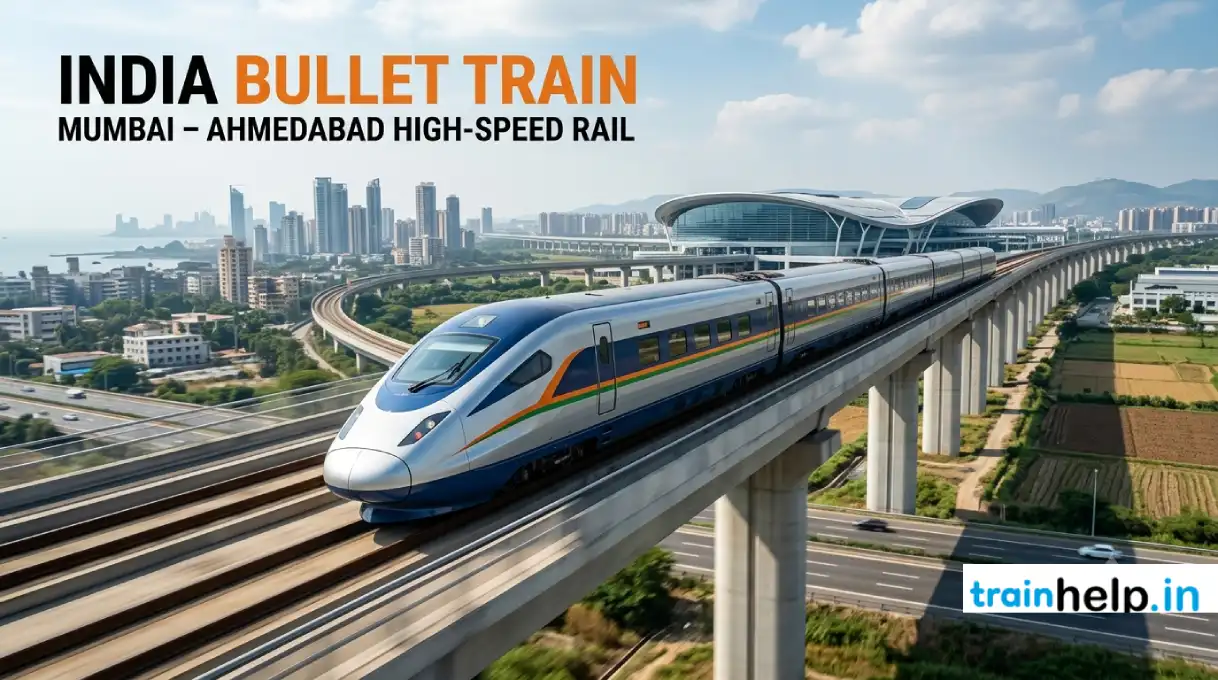
Bullet Trains in India: Latest Update on the Mumbai – Ahmedabad Project and New Corridors
The bullet train is no longer just a dream for India. Along the 508 km stretch between Mumbai and Ahmedabad, concrete pillars now line the horizon for hundreds of kilometres, tunnels have been dug through the hills of Maharashtra, and station buildings are rising at both ends. India’s first high-speed rail line is being built, and the government has already approved seven more corridors for the future.
Here is a simple, up-to-date guide on where bullet trains in India stand right now, when the first one will run, the full route and stations, and which cities are next in line.
India’s First Bullet Train: Mumbai to Ahmedabad
India’s first bullet train will run on the Mumbai – Ahmedabad High Speed Rail (MAHSR) corridor. It is being built by the National High Speed Rail Corporation Limited (NHSRCL) using Japanese Shinkansen technology, the same technology behind Japan’s famous bullet trains.
Here are the basics every reader should know:
- Total length: 508 km, with 352 km in Gujarat and Dadra and Nagar Haveli, and 156 km in Maharashtra.
- Number of stations: 12 stations in total.
- Top speed: designed for up to 320 km per hour in operation.
- Travel time: the current 7-hour train journey will drop to about 1 hour 58 minutes with limited stops, and 2 hours 17 minutes if the train halts at all 12 stations.
When Will the First Bullet Train Run?
This is the question everyone asks. As per the Railway Minister, the first bullet train is expected to make its inaugural run on the 100 km Surat to Vapi section in August 2027. This shorter stretch in Gujarat will open first because construction there is well ahead of the Maharashtra side.
The line will then open in phases. The Vapi to Surat, Vapi to Ahmedabad and Thane to Ahmedabad stretches will start before the full Mumbai to Ahmedabad service. The complete 508 km corridor is targeted for December 2029.
Note: Timelines for large infrastructure projects can shift. Land acquisition delays on the Maharashtra side and rising costs have pushed dates in the past, so treat these as target dates, not final promises.
All 12 Bullet Train Stations
The corridor runs from the Bandra – Kurla Complex (BKC) in Mumbai to Sabarmati in Ahmedabad. The 12 stations are:
In Maharashtra: Mumbai (BKC), Thane, Virar and Boisar.
In Gujarat and Dadra and Nagar Haveli: Vapi, Bilimora, Surat, Bharuch, Vadodara, Anand, Ahmedabad and Sabarmati.
How Much Work is Actually Done?
Quite a lot. According to the NHSRCL progress update, the project has crossed the halfway mark and is now in its most active phase. Some key figures from the 2026 updates:
- Over 352 km of viaduct (the elevated track structure) completed.
- More than 446 km of pier work completed.
- 17 river bridges finished out of a planned 25.
- Four mountain tunnels completed. Seven of the eight mountain tunnels fall in Palghar district in Maharashtra.
- Track bed laying, overhead electric wire masts and noise barriers are progressing steadily.
The most challenging part is the 21 km BKC to Shilphata tunnel in Maharashtra, which includes a 7 km undersea tunnel below Thane Creek. This will be the first undersea rail tunnel in India.
Which Train Will Run on the Tracks?
Two types of trains are planned for the corridor. In the early phase, Japanese Shinkansen train sets will be used. Japan is also gifting India two retired inspection train sets, including the well-known “Doctor Yellow”, to help test the line before the opening.
At the same time, India is building its own high-speed trains. The Integral Coach Factory (ICF) in Chennai, along with BEML, is designing indigenous train sets based on the Vande Bharat platform, meant to run at an average of 250 km per hour with a top speed of around 280 km per hour. The first made-in-India prototype is expected by December 2026. These trains will have air-conditioning, reclining seats, entertainment systems and facilities for passengers with mobility needs.
Seven New Bullet Train Corridors Approved
Bullet trains in India are not limited to the Mumbai-Ahmedabad line. In the Union Budget 2026-27, the government approved a large blueprint for seven new high-speed rail corridors across the country. These new corridors are:
- Mumbai to Pune
- Pune to Hyderabad
- Hyderabad to Bengaluru
- Hyderabad to Chennai
- Chennai to Bengaluru
- Delhi to Varanasi
- Varanasi to Siliguri
Most of these are still in the survey or Detailed Project Report (DPR) stage. Two of the most talked-about future routes are the Delhi to Varanasi corridor, which would cut an 11 to 12 hour journey to under four hours and may include a spur line to Ayodhya, and the long Delhi to Varanasi to Siliguri corridor, which is being planned as one of the longest high-speed routes in the country.
Why Bullet Trains Matter for India
High-speed rail runs on its own dedicated tracks, separate from goods trains and slower passenger trains. This means fewer delays and predictable timings. For busy city pairs like Mumbai and Ahmedabad, or Delhi and Varanasi, a bullet train can turn a full day of travel into a short trip of a few hours. It also offers a faster and greener option compared to flying short distances or driving on crowded highways.
Frequently Asked Questions
When will India’s first bullet train start?
The first run is expected on the Surat to Vapi section in Gujarat by August 2027. The full Mumbai to Ahmedabad corridor is targeted for December 2029.
How fast will the bullet train go?
The corridor is designed for a maximum operating speed of around 320 km per hour. Indian-made train sets are being designed for about 250 to 280 km per hour.
How long will the Mumbai to Ahmedabad journey take?
About 1 hour 58 minutes with limited stops, compared to nearly 7 hours by the current fastest train.
How many bullet train projects does India have?
One is under construction (Mumbai-Ahmedabad) and seven more corridors were approved in the 2026-27 Budget, most still in the planning or survey stage.
Will the bullet train be expensive to ride?
Fares have not been officially announced yet. They are expected to be competitive with premium train and short-haul air travel on the same route. We will update this page once official fares are declared.
Quick Summary
| First corridor | Mumbai to Ahmedabad (508 km) |
| Technology | Japanese Shinkansen |
| Stations | 12 (4 in Maharashtra, 8 in Gujarat side) |
| Top speed | Around 320 km per hour |
| First run | Surat to Vapi, targeted August 2027 |
| Full corridor | Targeted December 2029 |
| New corridors approved | 7 (Budget 2026-27) |
India’s bullet train story is moving from paper to concrete. The Mumbai to Ahmedabad line is the first big step, and with seven more corridors on the drawing board, high-speed rail could soon connect many of the country’s biggest cities. We will keep this page updated as each new milestone is reached. For related reading, see our posts on the Vande Bharat Express, Hydrogen Trains, and Indian Railway History.
Excited about India’s first bullet train? Tell us in the comments which route you would want next.