

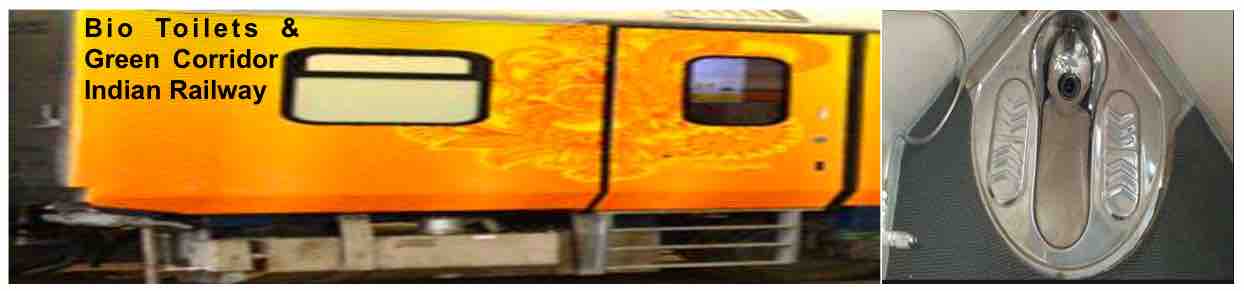
Bio-Toilets in Indian Railways: How They Work and Why They Choke
If you have travelled by train in the last few years, you have used a bio-toilet. Developed jointly by Indian Railways and DRDO, these tanks sit under the lavatory and use bacteria to break down waste instead of dropping it onto the track. This guide explains how they work, what they achieved, why they block so often, and what passengers can do about it.
The one thing that matters most: Bio-toilets fail when anything other than human waste and water goes into the pan. Bottles, napkins, nappies, cloth, plastic cups, gutkha pouches and cigarette ends do not break down, and they are the single biggest cause of blocked, overflowing toilets on Indian trains. Use the bin.
How a Bio-Toilet Works
The principle is simple, and it is the same one used in a septic tank, adapted to survive on a moving train.
- Waste from the lavatory drops into a sealed tank fitted beneath the coach.
- Inside, a colony of anaerobic bacteria breaks it down. These are bacteria that work without oxygen, originally isolated by DRDO for use in extreme cold at high-altitude military posts.
- The process converts waste largely into water and small quantities of gas.
- Gas escapes to the atmosphere, and the remaining water is chlorinated before being discharged onto the track.
The bacteria colony is the working part of the system. It needs to stay alive and undisturbed, which is why the tank is sealed and why foreign material causes so much trouble.
Indian Railways was the first railway system in the world to adopt this approach for onboard waste digestion, and the technology is entirely Indian.
Why It Was Introduced
Before bio-toilets, waste from train lavatories fell directly onto the track. The consequences were considerable:
- Corrosion of the rails and fittings, which is expensive and safety-relevant.
- Unhygienic conditions at stations and along the line.
- Difficult and unpleasant working conditions for track and coach maintenance staff.
The first installation came in January 2011, with 57 bio-toilets fitted to the Gwalior to Varanasi Bundelkhand Express. Fitment then expanded steadily across the fleet through the decade, aligned with the Swachh Bharat Mission, until essentially the whole passenger coach fleet was covered.
Why They Choke
This is the part most write-ups leave out, and it is what passengers actually experience.
The tank is designed for human waste and water. Anything else stays in the system, because bacteria cannot digest plastic, cloth or paper products. Over time these accumulate, block the outlet, and the toilet backs up. A single bottle can put a lavatory out of service for the rest of a journey.
| Never put in the pan | Bottles, plastic cups, food packets, napkins, sanitary items, nappies, cloth, rags, gutkha and pan masala pouches, cigarette and bidi ends, newspaper |
| Use instead | The bin provided in the toilet compartment or the vestibule |
Beyond blockages, the system has drawn criticism on other grounds. Digestion is not always complete, particularly when a tank is overloaded or the bacterial colony has been damaged, and smell complaints are common. Maintenance and periodic recharging of the bacterial culture matter a great deal to how well any individual toilet performs, which is why experience varies so much between coaches.
Bio-Vacuum Toilets: The Newer Version
Newer coaches, including Vande Bharat rakes, use an improved design called a bio-vacuum toilet. It keeps the same bio-tank underneath but adds an aircraft-style vacuum flush on top.
| Water use | Far lower, since suction does the work rather than volume of water |
| Blockages | Less frequent, because the vacuum clears the pan more forcefully |
| Cleanliness | Generally better, with less residue left in the pan |
| Refilling | Water tanks last longer, so coaches need topping up less often |
You can usually tell one by the sound. A bio-vacuum toilet flushes with a sharp suction noise rather than a flow of water.
Green Corridors
A Green Corridor is a stretch of railway where every train running on it has bio-toilets, so no human waste is discharged onto that section at all.
| Rameswaram to Manamadurai | India’s first Green Corridor section |
| Okha to Kanalus | Western Railway, Gujarat |
| Porbandar to Wansjaliya | Western Railway, Gujarat |
The Rameswaram section was chosen partly for its setting, since the line crosses the Pamban bridge over the sea, where discharge onto the track is particularly undesirable.
If the Toilet Is Dirty or Blocked
You do not have to put up with it. Report it during the journey, when something can actually be done.
- Note your coach number and berth, and the toilet’s position in the coach.
- Tell the coach attendant or the TTE first, since many issues can be dealt with on board.
- If nothing happens, raise it through Rail Madad or by calling 139.
- Complaints filed during the journey get attention far more often than those filed after you reach home.
See our guide on the Rail Madad app for how to lodge a complaint.
Frequently Asked Questions
What is a bio-toilet in a train?
A sealed tank fitted under the lavatory where anaerobic bacteria break waste down into water and gas, instead of the waste falling onto the track. The technology was developed by Indian Railways with DRDO.
Do all trains have bio-toilets now?
Fitment has been carried out across the passenger coach fleet, so you will find them on effectively any train you travel on. Newer coaches use the improved bio-vacuum version.
Why do bio-toilets smell or overflow?
Almost always because non-biodegradable items have been thrown into the pan and blocked the system. Overloading and poor maintenance of the bacterial culture also affect performance.
What should I not throw into a train toilet?
Bottles, plastic, napkins, nappies, sanitary items, cloth, gutkha pouches, cigarette ends and newspaper. Only human waste and water should enter the pan.
Is the waste discharged onto the track?
Not as waste. What leaves the tank is water, chlorinated before discharge, after the bacteria have done their work.
What is a bio-vacuum toilet?
An improved design combining a vacuum flush with the bio-tank. It uses much less water and blocks less often. Vande Bharat and other newer coaches have them.
What is a Green Corridor?
A railway section where every train running on it has bio-toilets, so no human waste is discharged on that stretch. Rameswaram to Manamadurai was the first.
Quick Summary
| Developed by | Indian Railways with DRDO |
| First fitted | January 2011, Bundelkhand Express |
| How it works | Anaerobic bacteria digest waste into water and gas |
| Discharge | Chlorinated water, not raw waste |
| Main problem | Blockages from non-biodegradable items |
| Newer version | Bio-vacuum toilets, on Vande Bharat and newer coaches |
| Complaints | Coach attendant or TTE first, then Rail Madad or 139 |
Bio-toilets solved a genuine problem, keeping waste off the tracks and out of stations, but they only work if passengers treat them properly. The bin takes two seconds and saves the next person a very unpleasant journey. For more, see our guides on Vande Bharat Express, and railway helpline numbers.
Have you had a bad experience with a train toilet? Tell us in the comments, and we will point you to the right way to complain.
Bio toilets are really good. But the levels of the toilet rooms are not in level due to which water gets accumulated in one place & due to these wetness increases in train coaches which makes unsafe for elderly to walk in corrioder of coach to reach their seat.
Taps are leaking in certain coaches.
Thank you, this is a useful observation and one that does not get discussed enough.
What you describe usually comes down to the floor drainage in the toilet compartment rather than the bio-toilet tank itself. If water is not draining away properly, it can spread into the vestibule on a moving train. Leaking taps are a separate maintenance issue that adds to it.
Your point about elderly passengers is the important one. A wet corridor on a moving coach is a genuine slip risk, particularly for someone walking to their berth with luggage. If anyone in your family needs help moving through a coach or station, our guide to senior citizen facilities and wheelchair services at stations may be useful.
Both are worth reporting, since both fall under coach maintenance. Note your coach number and where the toilet sits in the coach. Speak to the coach attendant or TTE first, as a leaking tap can sometimes be attended to on board. If that does not help, raise it through Rail Madad or by calling 139. Reporting during the journey is far more effective than afterwards, and a photograph helps.
If you travel the same route often and notice it on the same coaches, include the coach number in your complaint. That lets the maintenance depot identify the specific rake.
Do note that Train Help is an independent blog with no connection to Indian Railways or IRCTC, so we cannot act on service complaints ourselves. Rail Madad and 139 are the official channels.