

Train Safety Technologies by Indian Railway: Kavach and More (2026)
Indian Railways runs one of the largest rail networks in the world, and keeping millions of passengers safe every day needs strong technology. Over the years, Railways has added many safety systems, from automatic collision protection to modern train detection. This guide explains the main train safety technologies of Indian Railways in simple words, led by the flagship system Kavach, along with the latest 2026 rollout status.
Kavach: India’s Own Anti-Collision Shield
Kavach, which means armour or shield in Hindi, is India’s indigenously developed Automatic Train Protection (ATP) system. In simple terms, it is a safety net that can apply the train’s brakes automatically if the loco pilot fails to act in time. It was developed by RDSO (Research Design and Standards Organisation), the research wing of Indian Railways, based in Lucknow, and was adopted as the national ATP system in 2020.
Kavach carries a SIL-4 safety rating, which is the highest railway safety integrity level. Its earlier name was TCAS (Train Collision Avoidance System).
What Kavach Prevents
- SPAD (Signal Passed at Danger): stops a train that crosses a red signal, the classic cause of collisions.
- Over-speeding: enforces the maximum permitted speed for that section by braking automatically.
- Head-on and rear-end collisions: if two Kavach-fitted trains come on the same line, the system brakes both.
- Fog risk: gives the loco pilot in-cab signal information, so trains can run safely in dense fog without cutting speed drastically. This is a big help in North India during winter.
Tip: Kavach works only when both the track section and the locomotive are fitted with the system. That is why Railways is rolling it out corridor by corridor, along with fitting locomotives.
How Kavach Works
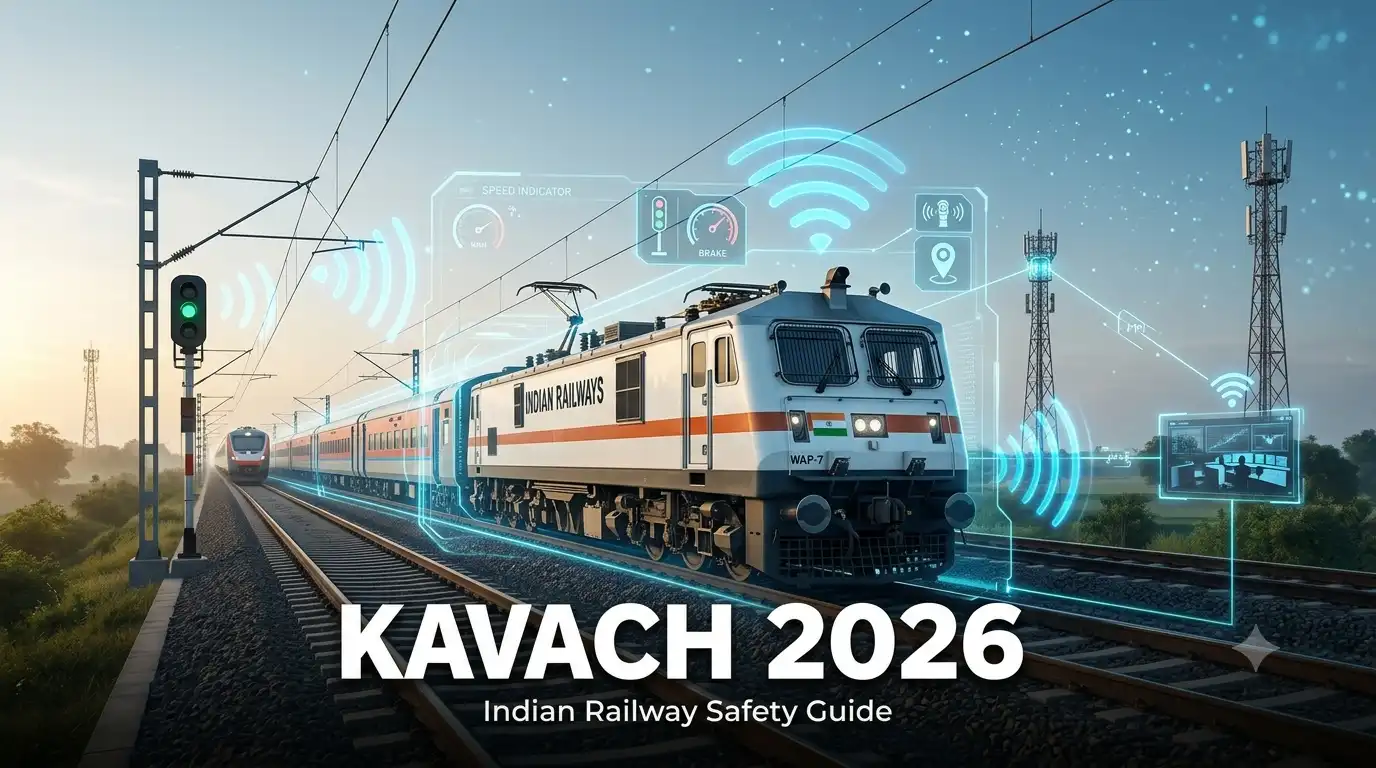
Kavach uses a mix of trackside and onboard equipment that constantly talk to each other:
- RFID tags along the track tell the train its exact location.
- Onboard units in the locomotive read the signals and speed limits.
- Trackside and station equipment, telecom towers and optical fibre cables link everything together.
- If the loco pilot does not slow down for a red signal or a speed limit, Kavach applies the brakes on its own.
The latest version, Kavach 4.0, was approved by RDSO in July 2024. It offers better location accuracy, clearer signal information in complex station yards, station-to-station communication over optical fibre, and direct integration with electronic interlocking.
Kavach Rollout Status in 2026
Kavach is being deployed in phases, starting with the busiest and most important corridors. Some key milestones reported through 2025 and 2026:
- Kavach 4.0 has been commissioned across several sections of the Delhi to Mumbai and Delhi to Howrah routes, including the Palwal to Mathura to Nagda stretch and the Vadodara to Virar section on Western Railway.
- On 30 January 2026, the 344 km Vadodara to Virar section was commissioned, and the Dadar to Bhuj Sayajinagri Express became the first Kavach-equipped train to run from Mumbai.
- The Virar to Mumbai Central section is targeted for completion by September 2026, which will bring Kavach right into the Mumbai suburban corridor.
- In July 2026, Railways approved Kavach 4.0 on 680 route km of the Rewari to Delhi and Shakurbasti to Bathinda sections of Northern Railway.
- Trackside work is underway across more than 24,000 route km covering the Golden Quadrilateral and other high-density routes, and thousands of locomotives are being fitted with Kavach units.
Even with this progress, Kavach still covers only a small part of the roughly 70,000 route km network, so the rollout is a multi-year national project.
Other Important Train Safety Technologies
Block Proving Axle Counter (BPAC)
A Block Proving Axle Counter is a reliable train detection system. It counts the axles of a train entering and leaving a section to confirm that the full train has arrived, with no coaches left behind due to a parting. Earlier this was checked by the station master visually observing the tail lamp or last-vehicle board. BPAC removes that human dependency, so a section is not wrongly cleared if a train arrives incomplete. It also prevents two trains from being allowed into the same block section at once, reducing collision risk. Indian Railways has installed BPAC widely, including large parts of the North East Frontier Railway network.
Electronic Interlocking
Electronic Interlocking uses computer-based systems to set routes, points and signals safely, replacing older mechanical and relay systems. It reduces human error, speeds up train movement, and works closely with modern systems like Kavach.
Fog Safety Devices
Railways provides GPS-based fog safety devices to loco pilots in fog-prone regions. The device announces the distance to the next signal or landmark, helping the pilot drive safely when visibility is very poor. Kavach further improves this with in-cab signalling.
LHB Coaches
Modern LHB (Linke Hofmann Busch) coaches are safer than the older ICF design. They resist climbing over each other in a derailment, have better anti-telescoping features, and offer smoother, safer high-speed running. Indian Railways has been steadily replacing old coaches with LHB rakes.
CCTV and Surveillance
Railways is installing CCTV cameras in coaches and at stations, along with facial recognition at some locations, to improve passenger security, especially for women travellers. On the Mumbai suburban network, security measures include panic buttons in ladies coaches and station safety audits.
Why These Technologies Matter
Most serious train accidents are caused by signal violations, over-speeding, or collisions. Systems like Kavach directly target these causes by taking over braking when needed, while BPAC and electronic interlocking make sure trains are detected and routed correctly. Together, they are steadily making Indian Railways safer, faster and more reliable.
Frequently Asked Questions
What is Kavach in Indian Railways?
Kavach is India’s own Automatic Train Protection system that automatically applies brakes to prevent collisions, signal violations and over-speeding. It was developed by RDSO and is a SIL-4 safety-rated system.
Who developed Kavach?
Kavach was developed by RDSO (Research Design and Standards Organisation), the research wing of Indian Railways, based in Lucknow.
What was the earlier name of Kavach?
Kavach was earlier known as TCAS (Train Collision Avoidance System).
Is Kavach installed on all trains?
No, not yet. Kavach is being rolled out corridor by corridor. It works only where both the track section and the locomotive are fitted with the system, so full national coverage will take several years.
Does Kavach help during fog?
Yes. Kavach gives the loco pilot in-cab signal information, which allows safer running in dense fog without cutting speed drastically.
Quick Summary
| Main system | Kavach (Automatic Train Protection) |
| Developed by | RDSO, Lucknow |
| Earlier name | TCAS |
| Latest version | Kavach 4.0 (approved July 2024) |
| Prevents | SPAD, over-speeding, collisions; helps in fog |
| Other systems | BPAC, electronic interlocking, fog devices, LHB coaches, CCTV |
Train safety technology is one of the biggest focus areas for Indian Railways today, and Kavach is at the heart of it. We will keep this page updated as the Kavach rollout reaches more routes, including the Mumbai suburban corridor. For related reading, see our posts on Bullet Trains in India and Vande Bharat Express.
Have a question about Kavach or train safety? Ask in the comments, and we will explain it in simple words.