

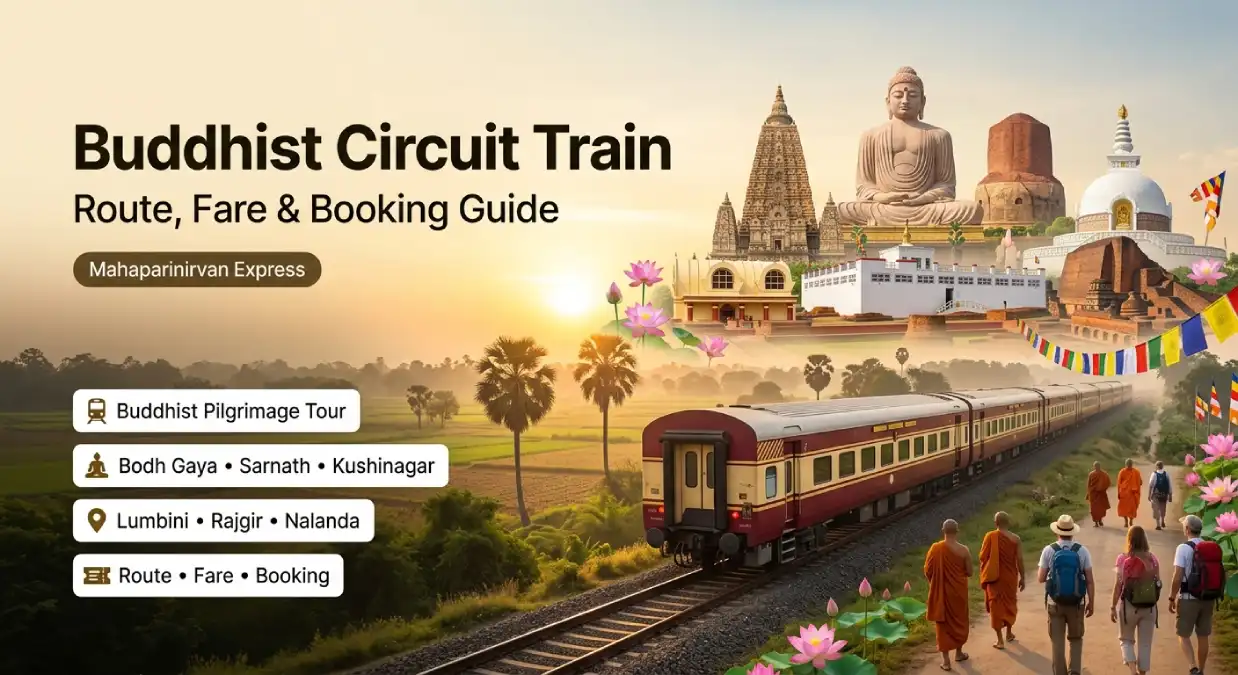
The Buddhist Circuit Tourist Train, long known as the Mahaparinirvan Express, is IRCTC’s pilgrimage train covering the major sites in the life of the Buddha. Over roughly a week it takes travelers from Delhi through Bodh Gaya, Nalanda, Kushinagar, Lumbini and Sravasti, with accommodation, meals, guides and monument entry all included. This guide covers the route, cabins, fares, booking and what to expect.
Check current departures before planning. IRCTC operates the Buddhist circuit train on scheduled departures through the cooler months, and both the itinerary and the fares are revised between seasons. Confirm the current schedule and price on IRCTC Tourism before booking flights or leave.
The Four Holy Sites
In the Mahaparinirvana Sutra, the Buddha told his followers that merit could be gained by visiting the places where he was born, attained enlightenment, first taught, and attained Nirvana. Those four sites anchor the journey:
| Lumbini | Birthplace, in Nepal |
| Bodh Gaya | Where he attained enlightenment under the Bodhi tree |
| Sarnath | Where he preached his first sermon |
| Kushinagar | Where he attained Mahaparinirvana |
The train itinerary covers these alongside other significant sites including Rajgir, Nalanda and Sravasti.
The Route
The journey begins and ends at Delhi Safdarjung station. A typical itinerary runs like this:
| Bodh Gaya | The Mahabodhi Temple, the Bodhi tree, and the Niranjana river |
| Rajgir and Nalanda | Gridhakuta Hill, Venuvan, Bimbisara Jail, and the ruins of Nalanda University |
| Sarnath | The Dhamek Stupa and the deer park where the first sermon was given |
| Kushinagar | The Mahaparinirvana Temple with its reclining Buddha, and Rambhar Stupa |
| Lumbini | Maya Devi Temple, the Ashokan Pillar and the Pushkarini pond |
| Sravasti | Jetavana Vihara, Pakki Kuti and the surrounding monasteries |
| Agra | The Taj Mahal and Agra Fort, on the return leg |
Nights are spent either on board or in hotels, depending on the stop. The exact order and inclusions vary by departure, so check the itinerary for your dates.
Lumbini is in Nepal. The itinerary crosses the border, so foreign nationals should check visa requirements carefully, particularly the rules on re-entry to India. Indian nationals travel to Lumbini without a visa but should carry photo identification.
Cabins and Accommodation
The train offers air-conditioned sleeper accommodation in two classes:
| AC First Class | Cabins with sliding doors that lock from inside, giving genuine privacy. Both four-berth and two-berth cabins are available. |
| AC 2 Tier | Curtained berths in the standard open layout, with less privacy but a lower fare. |
Off the train, guests stay in hotels at several stops. Some hotel stops are brief, intended for washing and changing rather than a full night, so pack with that in mind.
On Board
- Two dining cars, with everyone dining together.
- All meals included, along with tea, coffee and drinking water.
- A Train Manager travels throughout and handles requests and problems.
- Porters assist with luggage at boarding and alighting stations.
Fares
Fares are charged per person on twin sharing basis, with Indian nationals quoted in rupees and foreign nationals in US dollars.
| Class | Indian nationals | Foreign nationals |
|---|---|---|
| AC First Class | Around ₹76,800 | Around USD 1,155 |
| AC 2 Tier | Around ₹62,800 | Around USD 945 |
These figures are indicative. IRCTC revises tour package rates between seasons, and the dollar rate moves with the exchange rate. Take your quote from IRCTC Tourism for the departure you want.
Supplements
- Confirmed two-berth cabin in AC First Class carries a supplement.
- Single occupancy in hotels carries a supplement, charged either for the full tour or per stay.
- Sole use of lower berths, where the upper berths are left unallocated, carries a higher supplement.
What Is Included
Included: accommodation on the train and in hotels, all meals, guided off-train excursions with entrance fees and transport, an English-speaking guide, tea, coffee and mineral water on board, and porterage at stations.
Not included: taxes where applicable, insurance, gratuities, laundry, alcoholic drinks, telephone calls, video and professional camera fees, air tickets, airport transfers, and any accommodation before or after the tour.
Cancellation Terms
| When you cancel | Deduction |
|---|---|
| 45 days or more before departure | 10% of package cost |
| 44 to 15 days before | 25% |
| 14 to 7 days before | 50% |
| Within 7 days of departure | 100%, no refund |
The departure date itself is excluded from the count. Confirm current terms at booking, since they can change.
Practical Advice
- Bring comfortable walking shoes. The excursions involve a good deal of walking, often on uneven ground, and a moderate level of fitness is expected.
- Tell IRCTC about mobility needs at booking. Some excursions are difficult for those with walking difficulties, and arrangements are easier made in advance.
- Pack for the season. Northern India gets genuinely cold from December to January, with heavy fog. Lightweight cottons suit the warmer months, but carry woollens in winter.
- Allow buffer time after the tour. Winter fog delays trains, so do not book a tight onward connection on your return day.
- Mention dietary requirements at booking, and remind the chef or Train Manager on board.
- Carry your own medication, since brand names in India differ from those elsewhere.
- Take a night in Delhi before and after. The tour starts early and ends late, so a hotel at each end removes a lot of stress.
Booking
Book through IRCTC Tourism, which handles the Buddhist circuit train, or through authorised travel agents. The train can also be chartered for groups, conferences and events.
Note that departures require a minimum number of passengers to operate. If that number is not reached, IRCTC offers an alternative date, an alternative journey or a refund, with advance notice.
Frequently Asked Questions
✅ What is the Mahaparinirvan Express?
It is IRCTC’s Buddhist pilgrimage train, now generally known as the Buddhist Circuit Tourist Train. It covers the major sites in the Buddha’s life over roughly a week, starting and ending at Delhi.
✅ Which places does it cover?
Bodh Gaya, Rajgir, Nalanda, Sarnath, Kushinagar, Lumbini and Sravasti, with Agra on the return leg.
✅ How much does it cost?
Roughly ₹62,800 in AC 2 Tier and ₹76,800 in AC First Class per person on twin sharing, with foreign nationals charged in dollars. Rates are revised between seasons, so confirm on IRCTC Tourism.
✅ Is Lumbini included, and do I need a visa?
Yes, Lumbini in Nepal is part of the itinerary. Indian nationals need no visa but should carry photo identification. Foreign nationals should check Indian re-entry visa rules carefully before travelling.
✅ What is included in the fare?
Train and hotel accommodation, all meals, guided excursions with entry fees and transport, and porterage. Alcohol, laundry, gratuities and personal expenses are extra.
✅ Can children travel?
Yes. Children under 5 travel free sharing a berth with parents, and those between 5 and 12 pay half the adult fare sharing a bed. Taxes apply extra.
✅ How fit do I need to be?
Reasonably. The excursions involve considerable walking on uneven surfaces, and getting on and off the train can be awkward. Declare any mobility difficulty at booking.
Quick Summary
| Train | Buddhist Circuit Tourist Train, formerly Mahaparinirvan Express |
| Operated by | IRCTC |
| Starts and ends | Delhi Safdarjung |
| Covers | Bodh Gaya, Nalanda, Sarnath, Kushinagar, Lumbini, Sravasti, Agra |
| Classes | AC First Class and AC 2 Tier |
| Fare | From around ₹62,800 per person, twin sharing |
| Includes | Meals, hotels, guided excursions, entry fees |
| Booking | IRCTC Tourism |
For anyone wanting to see the major Buddhist sites without arranging transport, hotels and guides across two countries themselves, this train does the organising for you. Book early for winter departures, and allow a night in Delhi at each end. For more, see our guides on luxury trains in India and Bharat Darshan pilgrimage trains.
Have you travelled on the Buddhist circuit train? Tell us about it in the comments, since readers often ask what the pace is like.
- Kolkata Suburban Tourist Train Tickets
- Mumbai Suburban Tourist Train Tickets
- Chennai Suburban Tourist Train Tickets