

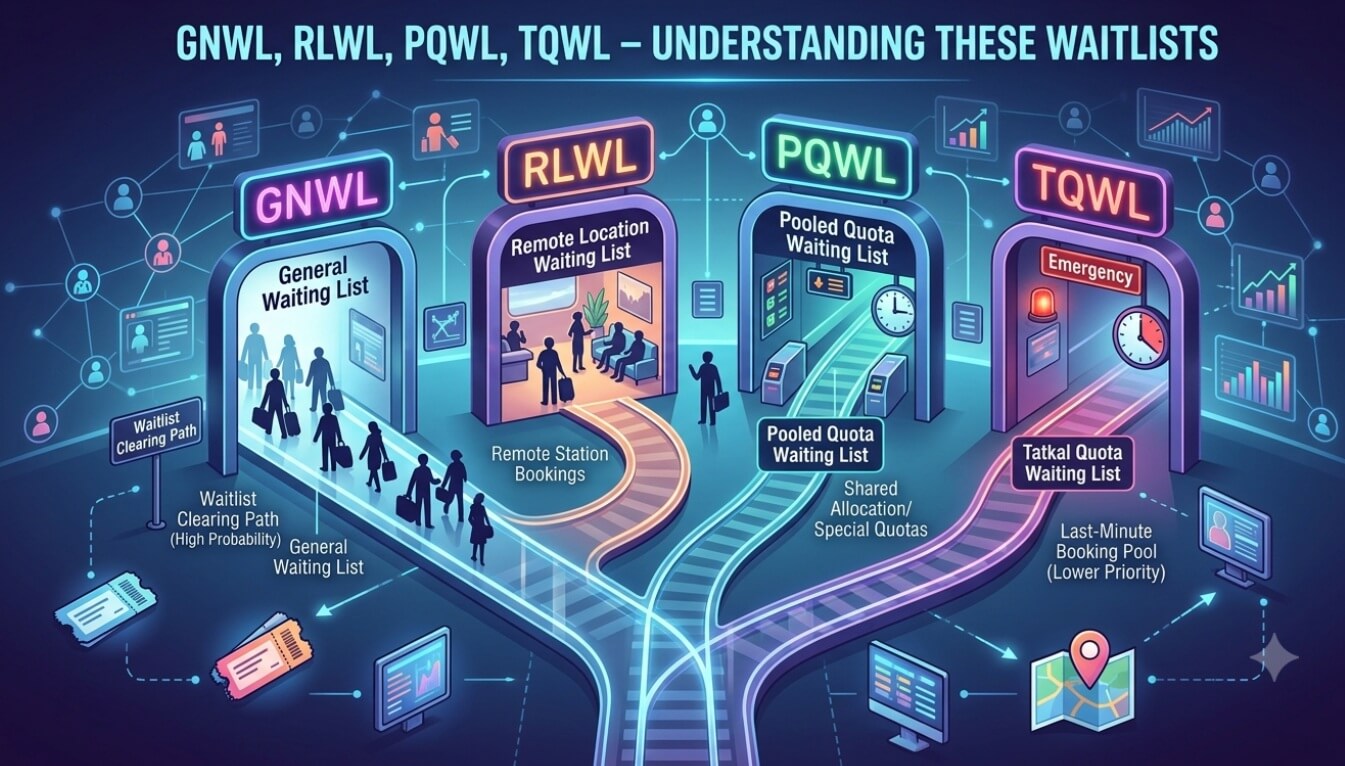
GNWL, RLWL, PQWL, TQWL : What Do These Waiting List Types Mean?
You checked your PNR status and the ticket shows something like GNWL 42 or RLWL 6 or PQWL 11. What does it all mean? And which one is more likely to get confirmed?
This guide explains all waiting list types in Indian Railways in simple language – so you know exactly what your ticket status means and what to expect.
Table of Content
What is a Waiting List (WL) Ticket?
GNWL : General Waiting List
RLWL : Remote Location Waiting List
PQWL : Pooled Quota Waiting List
TQWL : Tatkal Quota Waiting List
All Waiting List Types : Quick Comparison Table
Other Waiting List Types You May See
What Happens to WL Tickets at Chart Preparation?
Frequently Asked Questions (FAQs)
What is a Waiting List (WL) Ticket?
When all confirmed and RAC seats on a train are full, Indian Railways issues waiting list tickets. A waiting list ticket means you are in a queue for a seat. If passengers ahead of you cancel, your number moves up.
But here is the important part – <strong>not all waiting lists are the same</strong>. The type of waiting list on your ticket decides how fast it moves and how likely it is to get confirmed.
GNWL : General Waiting List
GNWL stands for General Waiting List. This is the most common and most favourable waiting list type.
GNWL is allotted when you book a ticket from the starting station of the train or from stations near the starting point (within the first few stops). These passengers are on the main quota of the train, so they benefit from every cancellation – no matter where the cancelling passenger boarded from.
Confirmation chances for GNWL: High. GNWL below 30 on most trains confirms well before the journey date. GNWL below 100 has a good chance of confirming, depending on the route and season.
RLWL : Remote Location Waiting List
RLWL stands for Remote Location Waiting List. This is allotted when you book a ticket from an intermediate station that is not the starting point of the train but has its own separate quota.
RLWL moves only when passengers who booked from the same origin station (or nearby) cancel. Cancellations from other stations do not affect your RLWL number.
Confirmation chances for RLWL: Moderate to High. RLWL below 10 on a busy intermediate station confirms most of the time. Since fewer people book from intermediate stations, even lower RLWL numbers move fast.
PQWL : Pooled Quota Waiting List
PQWL stands for Pooled Quota Waiting List. This is allotted when you book a ticket between two small intermediate stations that do not have their own separate quota.
These small station passengers share a common “pooled” quota with all other similar intermediate passengers. The PQWL is common and the waiting list is shared among many stations, so it moves very slowly.
Confirmation chances for PQWL: Low to Moderate. Only passengers in the same pooled quota who cancel will help your number move. PQWL below 5 has a reasonable chance, but above that, confirmation is uncertain.
TQWL : Tatkal Quota Waiting List
TQWL stands for Tatkal Quota Waiting List. This appears when you book a Tatkal ticket but the Tatkal quota is full and only a waiting list is available in that quota.
TQWL moves only when other Tatkal passengers on the same train cancel. Since Tatkal fares are higher, passengers are less likely to cancel a Tatkal booking. This makes TQWL one of the hardest waiting lists to confirm.
Confirmation chances for TQWL: Very Low. TQWL 1 or 2 may sometimes confirm, but anything above that is unlikely to move before chart preparation.
All Waiting List Types : Quick Comparison Table
| WL Type | Full Form | When You Get It | Moves When | Confirmation Chance |
|---|---|---|---|---|
| GNWL | General Waiting List | Booking from origin or near-origin station | Any cancellation on that train | ✅ High |
| RLWL | Remote Location Waiting List | Booking from major intermediate station with own quota | Cancellations from same origin quota | 🟡 Moderate to High |
| PQWL | Pooled Quota Waiting List | Booking between small intermediate stations | Cancellations in same pooled quota | 🟠 Low to Moderate |
| TQWL | Tatkal Quota Waiting List | Booking Tatkal ticket when Tatkal quota is full | Only Tatkal cancellations on same train | 🔴 Very Low |
Other Waiting List Types You May See
Apart from the main four, there are a few more codes you may come across:
RSWL : Road Side Waiting List
RSWL appears for passengers booking from very small roadside stations that fall along the train route. It works similarly to RLWL but for even smaller stops. Confirmation depends on how many passengers booked from that specific station segment cancel.
NOSB : No Seat Berth
NOSB is not a waiting list type as such. It is used for children between 5 and 11 years of age when they are booked without a separate berth (at child fare). The child travels on the same berth as the accompanying adult.
WL with No Prefix
Sometimes you may just see “WL 12” with no letters before it. This is the same as GNWL – it just means the general waiting list without any special prefix shown.
What Happens to WL Tickets at Chart Preparation?
When the train chart is prepared (usually 4 hours before departure), any waiting list ticket that has not moved to RAC or Confirmed status gets automatically cancelled by the system.
- If you booked online via IRCTC, the refund is automatically processed to your payment source.
- If you booked at a counter, you need to claim the refund at the ticket counter before departure.
- You cannot board the train with a WL ticket that remains unconfirmed after chart preparation.
Frequently Asked Questions (FAQs)
✅ Which waiting list type confirms the fastest?
GNWL confirms the fastest because it has access to the largest pool of cancellations from the entire train. RLWL comes second. PQWL and TQWL are the slowest to move.
✅ PQWL 1 : will it get confirmed?
PQWL 1 has a reasonable chance of confirmation but it is not guaranteed. Unlike GNWL 1 which almost always confirms, PQWL 1 depends only on cancellations from passengers in the same pooled quota – which can be very few.
✅ Can I travel if my WL ticket is not confirmed?
No. A waiting list ticket that remains WL even after chart preparation is automatically cancelled. You cannot board the train with that ticket.
✅ Is RLWL better than PQWL?
Yes. RLWL is generally better than PQWL because RLWL stations have their own dedicated quota. PQWL stations share a common pool with multiple other stations, making the movement slower.
✅ My ticket shows GNWL 150 – will it confirm?
GNWL 150 is a high number and confirmation is unlikely on most trains. However, during major cancellation spikes (like before a festival or after a sudden weather event), high GNWL numbers sometimes do move significantly. Keep checking your PNR status daily.
✅ Can I cancel a WL ticket and get a full refund?
Yes. If you cancel a WL ticket before the chart is prepared, you get a refund minus a small clerkage charge. If the WL ticket auto-cancels at chart preparation (for online bookings), the full refund minus clerkage is automatically processed.
✅ What does GNWL 1 mean?
GNWL 1 means you are first in the general waiting list. In most cases, GNWL 1 gets converted to RAC or confirmed status well before the journey date.
Also Read:
RAC Confirmation Chances – Will Your Ticket Get Confirmed?
Train Ticket Refund Procedures – Complete Guide
Change Name and Change Boarding Station of Train Tickets