

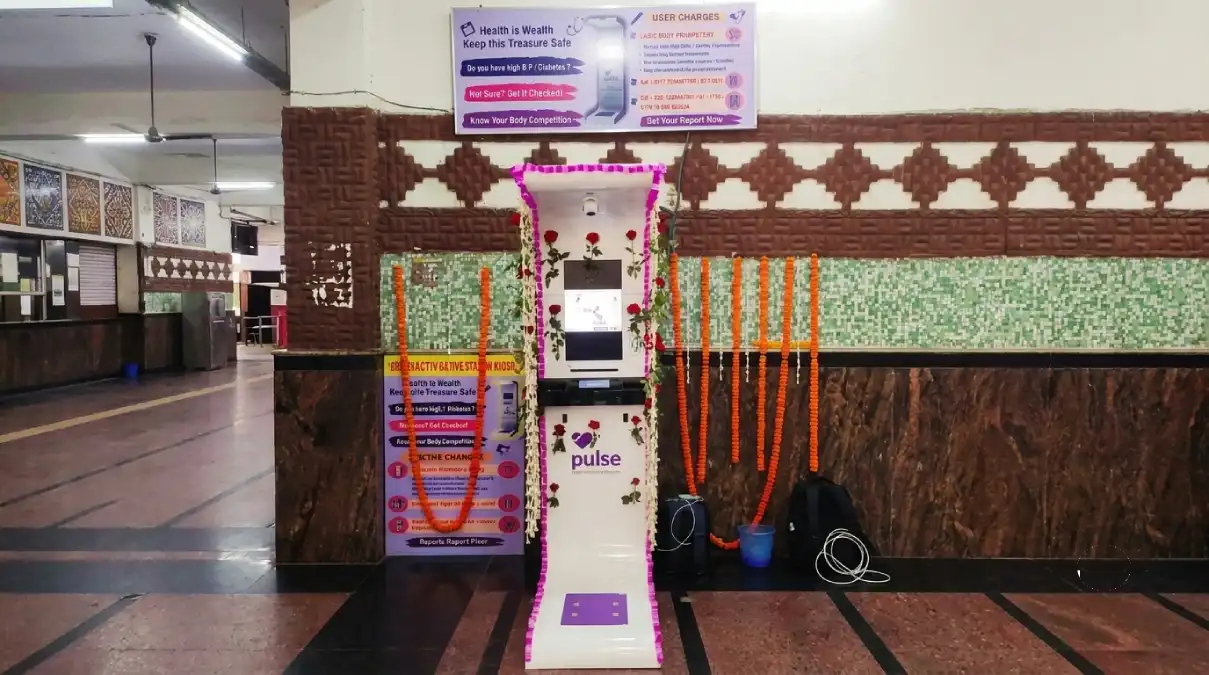
Health kiosks, also called health ATMs, are self-service machines installed at some railway stations where you can get basic health parameters checked in a few minutes for a small fee. This guide explains what they test, what they cost, where you might find one, and what they can and cannot tell you.
Availability varies considerably. These kiosks were introduced at selected stations as non-fare revenue projects, in phases across different zones. They are not present at every station, and a kiosk that existed at a station in the past may no longer be operating. Ask at the enquiry counter if you are looking for one.
What a Health Kiosk Does
A health kiosk is a walk-in booth with integrated medical devices, usually staffed by a paramedic or attendant. You complete a short set of measurements and receive a printed report within a few minutes.
Tests Commonly Offered
| Basic parameters | Height, weight, body mass index, body composition |
| Vital signs | Blood pressure, pulse rate, oxygen saturation |
| Blood tests | Random blood sugar, and at some kiosks haemoglobin and lipid profile |
| Report | A printed slip, sometimes with basic health recommendations |
Kiosks generally operate in two modes. The non-invasive mode covers measurements taken without a blood sample, such as weight, BMI, oxygen saturation and blood pressure. The invasive mode involves a finger-prick blood sample for sugar and related readings.
Some installations also offer video consultation with a doctor, though this is far from universal.
What It Costs
Charges vary between stations and operators, since different companies run them under different arrangements. As a general guide:
| Basic parameters only | Around ₹50 |
| Basic parameters with blood pressure and oxygen saturation | Around ₹80 |
| Full package including blood sugar | Around ₹100 |
Treat these as indicative rather than fixed. Check the displayed rate at the kiosk before starting, since prices differ by operator and have been revised over time.
What It Cannot Do
This matters more than anything else on the page.
A health kiosk is a screening tool, not a diagnosis. It gives you a set of numbers at a single point in time, taken in a busy public place by a machine, not a clinical assessment.
- A reading outside the normal range does not mean you have a condition, and a reading within range does not mean you do not.
- Blood pressure taken after rushing for a train, carrying luggage, is unlikely to reflect your resting reading.
- A random blood sugar reading is not the same as a fasting test or an HbA1c.
- The printed slip is not a substitute for seeing a doctor.
If a reading concerns you, take the slip to a doctor rather than acting on it yourself. The value of these kiosks is in prompting someone to seek proper advice, not in replacing it.
Where You Might Find One
Kiosks have been installed across several zones over the years, including at stations in Mumbai, Delhi, Hyderabad, Vijayawada, Nagpur, Bhopal, Lucknow, Asansol and parts of Karnataka.
Because these are commercial installations rather than a core railway facility, presence at any given station changes over time. Look for them in the circulating area or on the concourse, near other passenger amenities, and ask at the enquiry counter if you cannot find one.
Other Health Facilities at Stations
| Jan Aushadhi Kendras | Generic medicines at 50 to 90 per cent below branded prices, at over 100 stations. See our Jan Aushadhi guide |
| Medical assistance on trains | Call 139 and staff can arrange a doctor at an upcoming station. See our medical facilities guide |
| First aid | Available with the guard and at station first aid posts |
| Wheelchair assistance | Free on request at most stations. See our wheelchair guide |
Frequently Asked Questions
✅ What is a health kiosk at a railway station?
A self-service booth with medical devices where passengers can check basic health parameters such as BMI, blood pressure, oxygen saturation and blood sugar, receiving a printed report within minutes.
✅ How much does it cost?
Typically ₹50 to ₹100 depending on which tests you choose. Rates vary by station and operator, so check the displayed price.
✅ Which stations have health kiosks?
They have been installed at selected stations across several zones. Availability changes over time, so ask at the enquiry counter rather than assuming your station has one.
✅ Is the report reliable?
It is a screening indication, not a diagnosis. Readings taken in a busy station after physical exertion can differ from clinical measurements. Take any concerning result to a doctor.
✅ Do I need to book in advance?
No. Kiosks are walk-in.
✅ Where should I look for one?
In the circulating area or concourse, near other passenger facilities.
Quick Summary
| What it is | Self-service health screening kiosk at selected stations |
| Tests | BMI, blood pressure, oxygen saturation, blood sugar and others |
| Cost | Around ₹50 to ₹100 |
| Time | Results in a few minutes |
| Availability | Selected stations only, varies over time |
| Important | A screening tool, not a substitute for a doctor |
If you spot a health kiosk while waiting for a train, a basic check costs little and takes a few minutes. Just treat the result as a prompt to see a doctor if anything looks off, rather than as an answer in itself. For more, see our guides on Jan Aushadhi Kendras and medical facilities on trains.
Have you used a health kiosk at a station? Tell us which one in the comments, since readers often ask where to find them.