
 to nationalisation, electrification, Vande Bharat and the bullet train.)
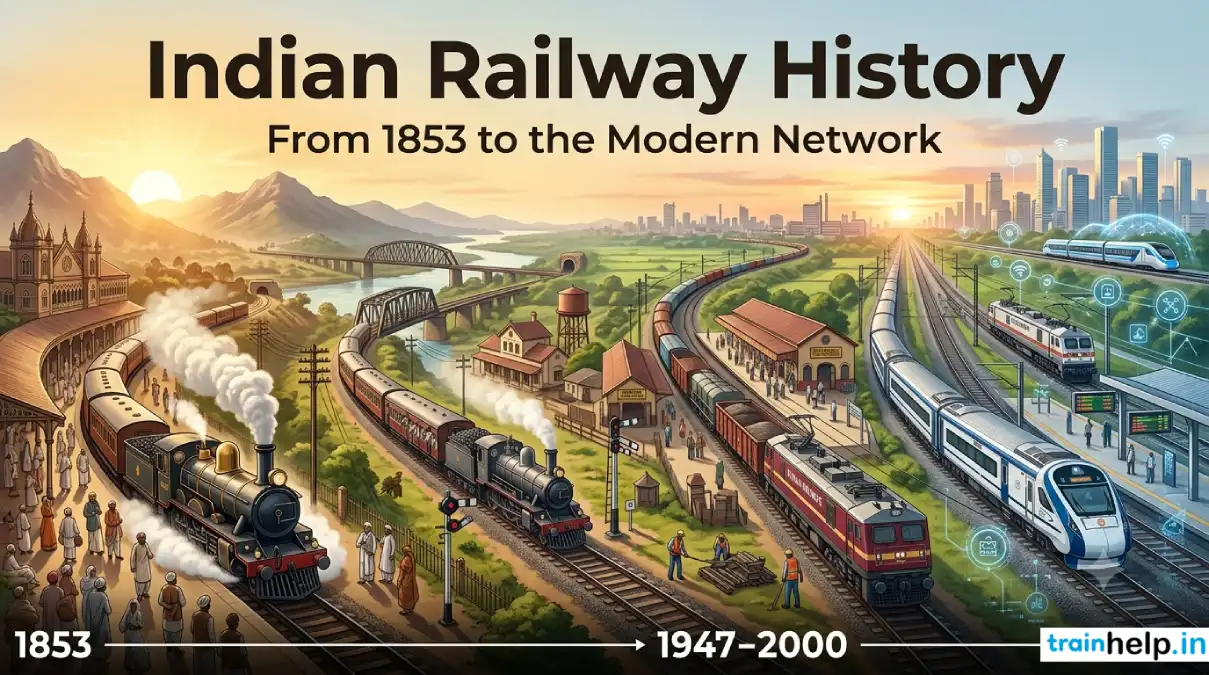
Indian Railway History: The Full Story from 1853 to Today
The Indian Railways is often called the lifeline of the nation. It carries crores of passengers every single day and connects the whole country, from the hills of the north to the coasts of the south. But how did it all begin? This guide walks through the history of Indian Railways in simple words, from the very first train in 1853 to the fast, modern network of today.
The First Train in India: 16 April 1853
The story begins on 16 April 1853. On that day, India’s first passenger train ran from Bori Bunder (Mumbai) to Thane, a distance of about 34 kilometres. The train was pulled by three steam engines named Sahib, Sindh and Sultan, and it carried around 400 passengers in 14 carriages.
The day was declared a public holiday, and thousands of people gathered to watch the historic journey. This single trip marked the birth of railways in India and in the whole of Asia.
Did you know? The first train left Bori Bunder at around 3:30 in the afternoon, and a 21-gun salute was fired to mark the occasion.
Why the British Built the Railways
The railways were introduced during British rule. The main reasons were commercial and administrative. The British wanted to move raw materials like cotton and coal quickly from the interior to the ports, transport goods for trade, and move troops and administration across the country faster.
While the intent was tied to colonial interests, the railways slowly changed India forever. They connected distant regions, helped people travel long distances, and later became a powerful force in uniting the country during the freedom movement.
Early Growth: 1853 to 1900
- 1853: First passenger train, Bori Bunder to Thane.
- 1854: The first train in eastern India ran from Howrah to Hooghly in Bengal.
- 1856: The first train in southern India ran in the Madras region.
- By the end of the 1800s, railway lines had spread across large parts of the country, linking major cities and ports.
Different private companies built these early lines, such as the Great Indian Peninsula Railway and the East Indian Railway, often with guarantees from the British government.
The Steam Engine Era
For nearly a century, Indian trains ran mainly on steam engines that burned coal. These powerful locomotives became a familiar sight and sound across the country. Steam engines slowly gave way to more efficient technology in the twentieth century, but they remain a beloved part of railway heritage. Some still run today on the hill railways as heritage attractions.
After Independence: Building One National Railway
At the time of independence in 1947, India inherited a railway network that was split among many private companies and princely states. In 1951, these separate systems were nationalised and brought together to form a single, government-run Indian Railways. This was a huge step, creating one of the largest railway systems in the world under one management.
Indian Railways was then organised into zones for easier administration, a structure that continues today with multiple zonal railways covering the whole country.
Modernisation: Electric and Diesel Trains
To move away from slow, coal-heavy steam engines, Indian Railways adopted diesel and electric locomotives. Electric trains, in particular, are cleaner, faster and cheaper to run over busy routes. Over the decades, more and more of the network was electrified, and today a very large share of train movement runs on electric traction.
The Computer and Internet Age
A major change for ordinary passengers came with computerised reservation, which ended the era of long manual booking registers. Later, online booking through IRCTC transformed how India books train tickets, letting people reserve seats from home. Mobile apps, e-tickets and digital payments made travel planning far easier.
New-Generation Trains
In recent years, Indian Railways has focused on faster and more comfortable trains:
- Rajdhani, Shatabdi and Duronto trains brought premium, high-speed intercity travel.
- Vande Bharat Express, a modern engine-less semi-high-speed train, marked a big leap in indigenous design and passenger comfort.
- Amrit Bharat and other new trains aim to bring better facilities to more travellers.
- India’s first bullet train project, on the Mumbai to Ahmedabad corridor, is under construction and will bring true high-speed rail to the country.
Safety technology has also advanced, with systems like Kavach, India’s own automatic train protection system, being rolled out to prevent collisions.
Indian Railways Today
Today, Indian Railways is one of the largest rail networks in the world, spanning tens of thousands of route kilometres and thousands of stations. It carries crores of passengers and huge volumes of freight every day. From suburban locals in cities like Mumbai to long-distance expresses crossing the country, and now metro systems in many cities, rail remains central to how India moves.
Timeline at a Glance
| Year | Milestone |
|---|---|
| 1853 | First passenger train: Bori Bunder to Thane |
| 1854 | First train in eastern India (Bengal) |
| 1856 | First train in southern India (Madras region) |
| 1925 | First electric train runs in the Mumbai area |
| 1947 | Independence; network split among many systems |
| 1951 | Railways nationalised into one Indian Railways |
| 1980s to 1990s | Computerised reservation introduced |
| 2002 onwards | Online booking through IRCTC |
| 2019 | Vande Bharat Express introduced |
| Present | Bullet train under construction; Kavach safety rollout |
Frequently Asked Questions
When did the first train run in India?
India’s first passenger train ran on 16 April 1853, from Bori Bunder (Mumbai) to Thane, a distance of about 34 km.
What were the names of the first three engines?
The three steam locomotives that pulled the first train were named Sahib, Sindh and Sultan.
Who introduced railways in India?
Railways were introduced during British rule, mainly to move goods and troops, though they later transformed travel and trade for all of India.
When was Indian Railways nationalised?
The separate railway systems were brought together into a single, government-run Indian Railways in 1951.
What is the newest kind of train in India?
The Vande Bharat Express is a modern semi-high-speed train, and India’s first true bullet train (Mumbai to Ahmedabad) is under construction.
Quick Summary
| First train | 16 April 1853, Bori Bunder to Thane |
| First engines | Sahib, Sindh, Sultan |
| Nationalised | 1951, into one Indian Railways |
| Traction today | Mostly electric, plus diesel |
| Modern trains | Vande Bharat, Amrit Bharat, bullet train (under construction) |
From a single 34 km journey in 1853 to a vast national network today, the history of Indian Railways is really the story of modern India itself. As the railways move into the era of bullet trains and smart safety systems, that journey is still going strong. For more, see our posts on the Vande Bharat Express, Bullet Trains in India, and Train Safety Technologies (Kavach).
Which part of Indian Railways history surprised you the most? Tell us in the comments.