

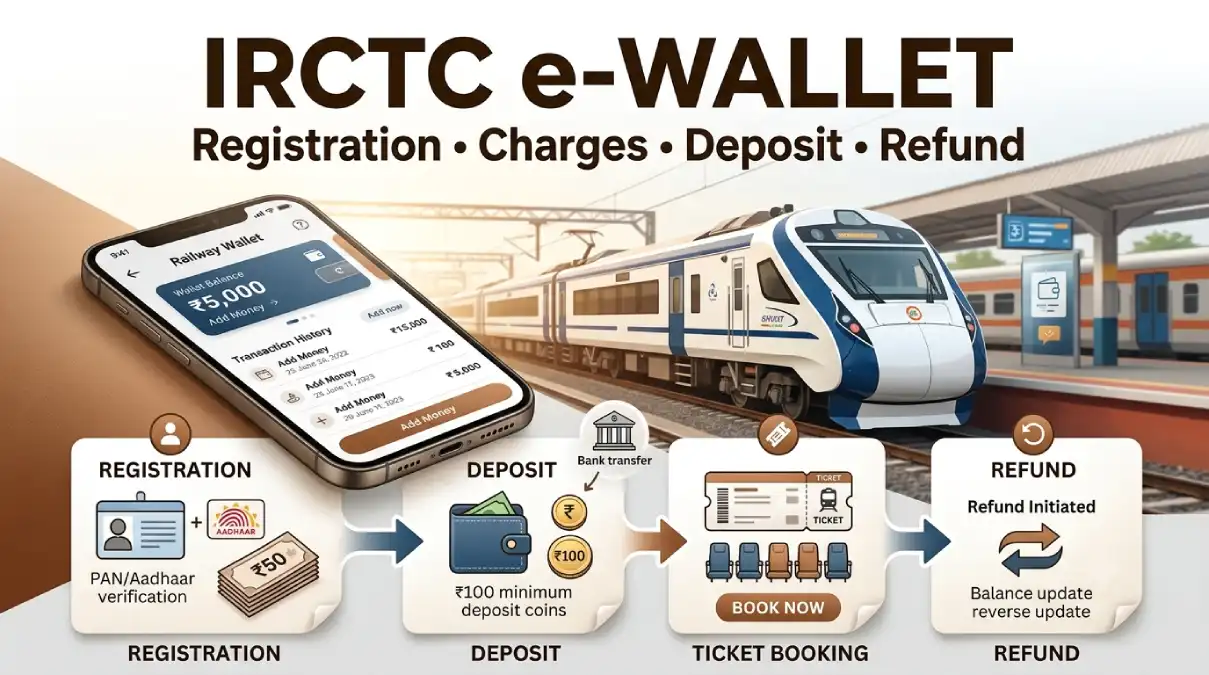
IRCTC e-Wallet: Registration, Charges, Deposit and Refund Rules (2026)
The IRCTC e-Wallet is a prepaid deposit facility on IRCTC. You add money to it in advance, then spend that balance when you book a train ticket, so you skip the bank payment gateway every time. This guide covers how the scheme works, how to register and deposit, what it costs, how refunds reach you, what happens to your balance when you close the account, and whether it still makes sense in 2026.
Disclaimer: Train Help is an independent information website and is not affiliated with, endorsed by, or connected to IRCTC or Indian Railways. This page is for general information only. All trademarks belong to their respective owners. For booking, payments and official rules, always use the official IRCTC website and app.
What is the IRCTC e-Wallet?
Think of it as a prepaid balance that you hold with IRCTC itself. Once money sits in your wallet, booking takes one step fewer, because IRCTC deducts the fare straight from that balance instead of sending you to your bank for approval. Alongside it, you can still pay by UPI, card, net banking or IRCTC’s own iPay gateway.
In regulatory terms, the e-Wallet counts as a closed system prepaid payment instrument (PPI) under RBI rules. That status explains its most discussed limit: you may spend the balance only on train tickets from IRCTC, and you cannot pull it out as cash.
Important 2026 Position on Your Balance
Key update: In December 2025, the Railway Minister told Parliament that you cannot withdraw cash from the IRCTC e-Wallet, because it works as a closed system PPI account. You may spend the deposit only on train tickets. However, IRCTC has decided that both existing and new users will get their remaining balance back in their bank account when they close the e-Wallet account. So your money never disappears, although you cannot treat it like a savings balance while the account stays open.
Why People Use It
- Faster checkout: you skip the bank approval step, which saves precious seconds during a busy booking.
- No dependence on one bank: even when your bank gateway crawls or goes offline, your wallet balance still works.
- Lower cost per booking: you save the payment gateway charge each time.
- Quicker refunds: after a cancellation, IRCTC credits the money back to your wallet, usually by the next day, instead of making you wait for a bank cycle.
- Clear records: IRCTC lists your deposits and your wallet bookings on separate pages inside your account.
Charges: What It Costs
| Charge | Details |
|---|---|
| Registration fee | One-time fee at sign-up, plus GST. Non-refundable. |
| Transaction charge | A small fee deducted on each booking paid from the e-Wallet, plus GST. |
| Deposit limits | A minimum deposit applies, and there is a cap on the balance you may hold. |
Important: IRCTC has revised the registration fee, the per-transaction charge and the balance cap more than once, so different websites quote different amounts. Trust the figures that IRCTC shows on the registration and payment screens rather than older articles. Remember also that IRCTC keeps the registration fee even if you close the account later.
Who Can Register
Before you start, make sure you have all three of these:
- An IRCTC account with a working login.
- PAN or Aadhaar, which IRCTC verifies through an online KYC check.
- Indian nationality and an Indian mobile number on your IRCTC profile.
How to Register for the e-Wallet
- Log in to the IRCTC e-ticketing website or the official app.
- Open the IRCTC eWallet section, then choose the register option.
- Pick PAN or Aadhaar for verification and enter the details carefully. If you choose Aadhaar, IRCTC saves the KYC response to your profile.
- Pay the one-time registration fee through any available payment option.
- Create a transaction password or PIN, which you will need for every wallet booking, and confirm it.
- Once the payment succeeds, the system logs you out and shows a success message. Simply log back in and start using the wallet.
The Deposit Scheme: Adding Money
Many people call the deposit side of this facility the IRCTC deposit scheme. Here is how you top up.
- Log in, then open the IRCTC eWallet Deposit option.
- Enter the amount you want to add, staying within the minimum and maximum limits on screen, and confirm it.
- Pick a payment method such as UPI, card or net banking, then complete the payment.
- The money lands in your wallet, and a success message appears.
To confirm that a deposit went through, open the Deposit History page under the wallet menu, which lists the status of every top-up you have made.
Tip: Sometimes money leaves your bank but never reaches your wallet. In that case, IRCTC returns it to the same payment source once your bank confirms the failed transaction. Meanwhile, keep the bank reference number safe, and raise it with IRCTC customer support if nothing moves within a few days.
How to Book a Ticket Using the e-Wallet
- Search your train and fill in passenger details as usual.
- On the payment page, choose IRCTC eWallet. The screen then shows your available balance.
- Enter your transaction password or PIN.
- Type the OTP that reaches your registered mobile or email, then confirm.
- IRCTC debits the fare plus the wallet transaction charge, and confirms your ticket.
Remember that a booking succeeds only when your balance exceeds the total amount payable. Therefore, top up before a heavy booking day rather than at the last minute.
Cancellation and Refund
- Cancel from Booked Ticket History under My Transactions, exactly as you would with any other IRCTC ticket.
- IRCTC credits the refund back to your wallet account rather than your bank, usually by the next day.
- You can spend that refunded balance on your next booking, although you cannot take it out as cash while the account stays open.
- For the wider refund picture, see our Train Ticket Refund Status guide.
Transaction Password: Change or Reset
Your transaction password works separately from your IRCTC login password. If you forget it, go to My Account, then My Profile, then Forgot Transaction Password, and follow these steps:
- Enter your IRCTC registered email ID.
- Type your IRCTC login password.
- Request the OTP, then enter the code that reaches your registered mobile.
- Set a new transaction password and confirm it.
Checking Your History
| What you want to see | Where to look |
|---|---|
| Money you added to the wallet | Deposit History |
| Bookings paid from the wallet | IRCTC eWallet Transaction page |
| Refunds credited back | e-Wallet transaction and booking history |
You can filter bookings by date of journey or booking date, and you can open any entry through its transaction ID.
What Happened to IRCTC iMudra?
Many older guides still list iMudra as an IRCTC wallet option, but it no longer exists. IRCTC discontinued the iMudra wallet and prepaid card, and the programme went inactive from 2 January 2023. After that, IRCTC returned the remaining balances to users’ verified bank accounts once they completed KYC, starting from 20 January 2023.
Therefore, in 2026 the e-Wallet stands as the one prepaid option that remains on IRCTC. If an old iMudra balance still troubles you, raise it with IRCTC customer support directly.
Is the e-Wallet Still Worth It in 2026?
That question deserves a straight answer, because payment options have improved a great deal. UPI now settles instantly and adds no charge of its own on IRCTC, which cancels much of the speed advantage the wallet once held over slow bank gateways.
Still, the e-Wallet suits you well if you:
- Book frequently and want the shortest possible payment step;
- want a fallback when a bank gateway fails at a critical moment;
- prefer refunds landing in one place, ready for your next trip.
On the other hand, it suits you less if you travel only occasionally, because you pay a non-refundable registration fee and a charge on every transaction. In that case, UPI or IRCTC iPay works out simpler. Finally, check the current availability window before you rely on it for a rush booking, since IRCTC has restricted wallet booking during certain morning hours in the past.
Frequently Asked Questions
Can I withdraw money from my IRCTC e-Wallet?
Not as cash, because it works as a closed system PPI account, so you may spend the balance only on train tickets. However, IRCTC transfers the remaining amount to your bank account when you close the wallet account.
Does IRCTC refund the registration fee?
No. You pay that one-time fee once, and IRCTC keeps it even if you stop using the wallet.
What do I need to register?
PAN or Aadhaar for the online verification step, plus an IRCTC account. IRCTC offers this facility to Indian nationals who hold an Indian mobile number.
Where does my refund go if I cancel a ticket?
Straight back into your wallet account, usually by the next day, ready for another booking.
Does IRCTC iMudra still work?
No. IRCTC discontinued iMudra from January 2023, then returned remaining balances to verified bank accounts after KYC.
Should I use the e-Wallet or UPI?
Choose UPI if you travel occasionally, since it costs nothing extra and settles instantly. Alternatively, choose the wallet if you book often and value the fastest payment step plus a backup when a bank gateway fails.
Quick Summary
| What it is | Prepaid closed system wallet with IRCTC for booking tickets |
| Verification | PAN or Aadhaar (online KYC) |
| Charges | One-time registration fee plus per-transaction charge, both with GST |
| Registration fee | Non-refundable |
| Balance use | Train tickets only, no cash withdrawal |
| On account closure | Balance transferred back to your bank account |
| Security | Transaction password or PIN, plus OTP |
| iMudra | Discontinued since January 2023 |
Overall, the IRCTC e-Wallet earns its place if you book train tickets often and want the payment step out of the way quickly. Keep a working balance topped up, remember your transaction password, and check the current fees on IRCTC before you register. For more, see our guides on Railway Ticket Enquiry and Booking, Train Ticket Refund Status, and R-Wallet by Indian Railway.
Do you use the IRCTC e-Wallet? Tell us in the comments whether it actually saves you time at booking.