
 in Indian Railway: what they are, the three foils, when railways still issue them, key rules, advance issue and refund procedure.Update the featured image alt to "Blank paper tickets BPT in Indian Railway rules and uses".)
Blank Paper Tickets (BPT) in Indian Railway: What They Are and When They Are Used
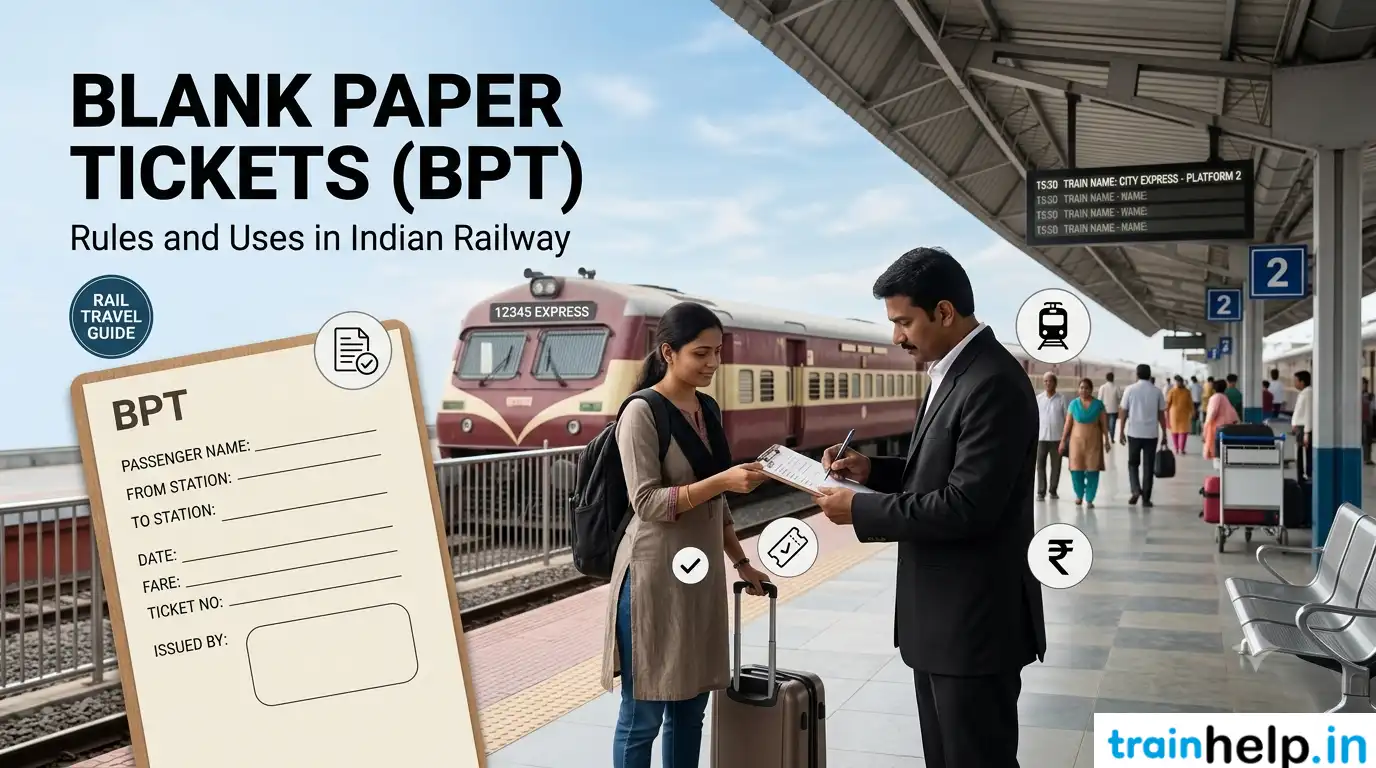
A blank paper ticket, usually shortened to BPT, is a manually written railway ticket issued from a book rather than printed in advance for a fixed route and fare. Because almost all ticketing now runs through computerised systems, most travellers never see one. Even so, the provision survives for particular situations, and it remains a standard topic for anyone studying railway commercial subjects. This guide explains what a BPT is, where it still applies, how it is issued, and how refunds work.
What Makes a Blank Paper Ticket Different
An ordinary printed card ticket already carries the destination, class, route and fare. A blank paper ticket carries none of that in advance. Instead, the booking clerk writes in the details at the time of issue: the destination station, the class, the route, the type of train, the distance and the fare.
Each ticket prints in three copies, or foils, so that everyone who needs a record gets one:
| Foil | Who keeps it |
|---|---|
| Passenger | The traveller, as the ticket itself |
| Station Record | The issuing station, for its own records |
| Accounts | The accounts office, for revenue reconciliation |
The tickets come in book form, carry serial numbers, and print on watermarked paper, all of which guards against misuse. Staff verify that every foil remains intact when they receive a new book.
When Blank Paper Tickets Are Still Used
Since computerisation, these tickets survive mainly as a fallback and for cases the standard system does not cover neatly:
- Concession orders and warrants. Staff issue a BPT in exchange for authorised concession orders, police warrants and similar documents.
- System or power failures. When a booking counter cannot issue computerised tickets, manual tickets keep the counter working.
- Stations without computerised facilities. A small number of locations still rely on manual booking.
- Certain party bookings. Where a group needs reserved accommodation and the administration decides a single manual ticket suits better.
- Unusual routings. Journeys that printed card tickets do not cover, particularly across several zonal railways by a specific route.
For most travellers: You will book through IRCTC, the RailOne app or a computerised counter, and you will receive an e-ticket or a printed counter ticket. A blank paper ticket is not something you request. Staff issue one only when the situation calls for it.
Key Rules That Apply
One Ticket, One Passenger
Each blank paper ticket covers a single passenger, whether adult or child. For child fare rules, see our child fare guide.
The Route Must Appear on the Ticket
Because many destinations can be reached by more than one route, the clerk records the route on the ticket. When a journey crosses two or more zonal railways and several routes exist, the ticket shows the first junction on each railway along with that railway’s code. So staff ask which way you intend to travel, and they issue accordingly.
Corrections Are Not Allowed
Nobody may alter a blank paper ticket once written. If wrong details go onto a ticket, staff cancel it entirely and treat it as non-issued, then write a fresh one. This rule protects the audit trail, and it applies to related manual ticket types too.
Party Bookings During Heavy Rush
During peak periods, a railway administration may decide that one person should not corner several reserved berths. In such cases, staff can issue a single blank paper ticket for a party above a certain size when that party wants berths reserved together, even though printed card tickets remain in stock.
Advance Issue for Journeys Starting Elsewhere
Two useful provisions cover journeys that do not begin at the station where you buy the ticket.
- Return journeys ending at the booking station. You can buy a ticket up to a month ahead for a journey that starts at an outstation and finishes at the station where you are standing. Staff issue a blank paper ticket for this whether or not you bought an outward ticket.
- Journeys between two other stations. Selected stations may issue tickets for journeys that both start and end elsewhere. For instance, an authorised station could issue a ticket for a journey from Surat to Mumbai Central, or from Vadodara to Amritsar.
Important: The travel date written on such a ticket is fixed, and nobody may alter it afterwards. If you travel on a different date, staff treat you as travelling without a ticket and charge you accordingly. So make sure the date is right before you leave the counter.
Refunds on a Blank Paper Ticket
- At the issuing station: staff process the refund under the normal refund rules.
- At any other station: staff collect the ticket and give you a prescribed receipt in exchange. You then apply for the refund to the chief commercial authority of the zonal railway concerned.
Keep that receipt safe, since it becomes your only proof once the ticket itself goes back. For the wider refund picture, see our train ticket refund guide.
Historical Note: The Colour System
Older references describe blank paper tickets printed in different colours according to the fare band, with white covering the lowest values and green the highest, along with separate series for local and through traffic. Those bands date from a period when fares ran far lower than today, so treat the colour scheme as historical background rather than current practice. Computerised ticketing has replaced this system almost everywhere.
Frequently Asked Questions
What is a blank paper ticket?
It is a manually written railway ticket issued from a serially numbered book, with the destination, class, route and fare filled in by hand at the time of issue rather than pre-printed.
Can I ask for a blank paper ticket?
No. Staff issue one only where circumstances require it, such as against a concession order or warrant, or when computerised booking is unavailable.
How many foils does a blank paper ticket have?
Three: one for the passenger, one for the station record and one for accounts.
Does one blank paper ticket cover a family?
No. Each ticket covers one passenger, adult or child. Party bookings during heavy rush form a separate provision.
Can the details on a blank paper ticket be corrected?
No. Staff must cancel a wrongly written ticket, mark it as non-issued and write a fresh one.
How do I get a refund on one?
Return it at the issuing station for a normal refund. At any other station, staff take the ticket and give you a receipt, and you then apply to the zonal railway’s commercial authority.
Quick Summary
| What it is | Manually written ticket from a serially numbered book |
| Foils | Passenger, Station Record, Accounts |
| Covers | One passenger per ticket |
| Used for | Concession orders, warrants, system failures, certain party bookings |
| Corrections | Not permitted, ticket must be cancelled and rewritten |
| Advance issue | Up to a month for outstation journeys, date cannot be altered |
| Refund elsewhere | Ticket collected, receipt issued, apply to the zonal railway |
Blank paper tickets belong mostly to the older manual era of Indian Railways, yet the provision still fills gaps that computerised systems leave. For related reading, see our guides on circular journey tickets, break journey rules, and journey extension tickets.
Have you ever been issued a blank paper ticket? Tell us where and why in the comments, since they are rare these days.