

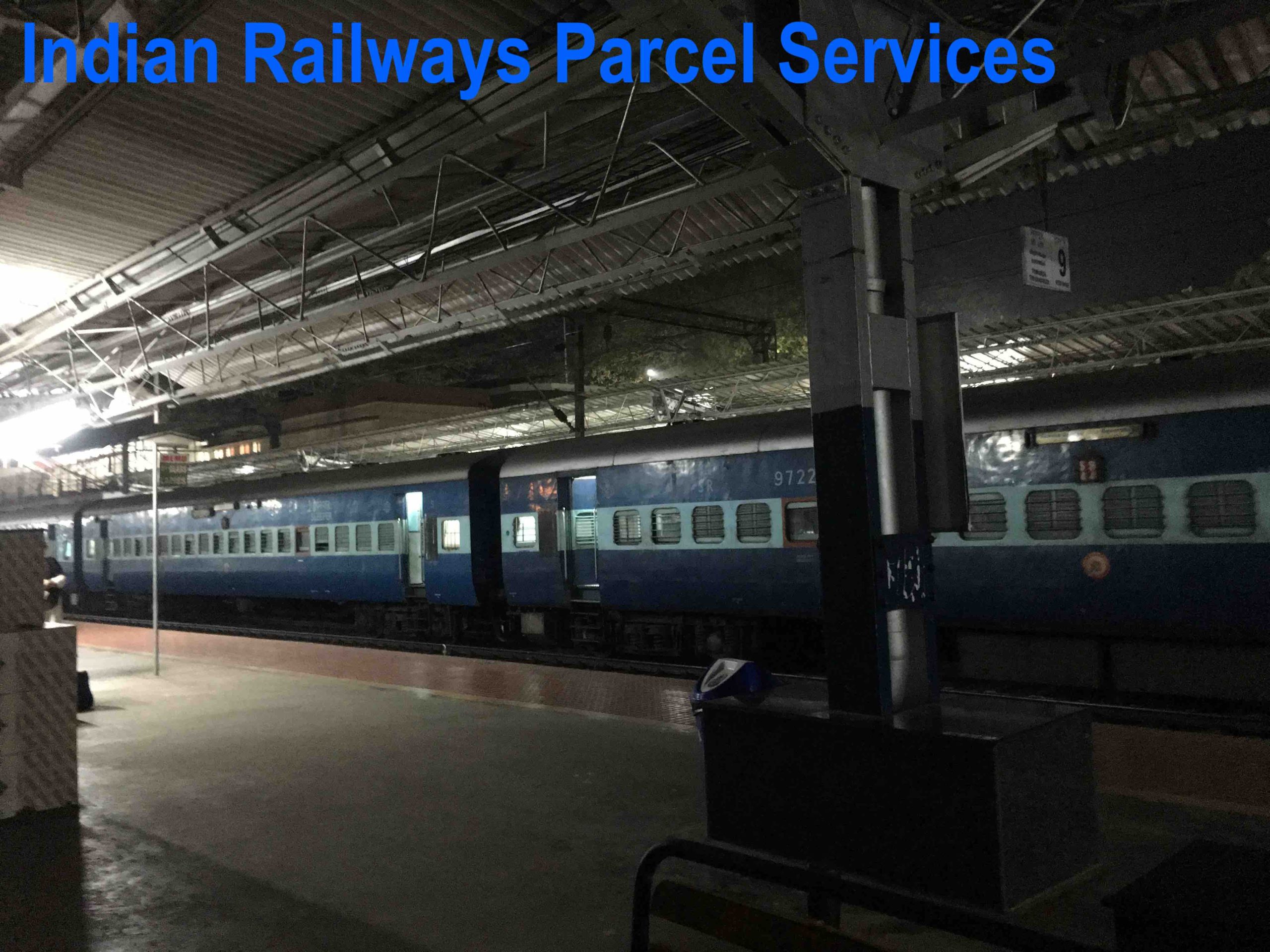
Parcel Luggage Booking, Tracking, Rates and Rules in Indian Railway (2026)
Here you will get complete information about the parcel sector in Indian Railway, including the parcel rates, the method to send a parcel, online and manual booking, tracking, collection rules and the full rate charts. Indian Railways is one of the cheapest and most reliable ways to send goods across the country, from fruits, vegetables and household items to cycles, motorcycles and cars.
On this page:
- Parcel Booking Methods ✅
- Step by Step Procedure of Parcel Booking (Online and Manual)
- Documents Needed
- Tracking Your Parcel
- Collection Time Limits
- Parcel Rate Structure and Scales
- Rate Charts (Scale L, R, P, S)
- Parcel Rules and Wharfage
- Downloads and Related Guides
- Frequently Asked Questions
Parcel Booking Methods
Indian Railways offers two ways to book a parcel:
✅ Online Booking Process of Parcels
✅ Manual Booking Process of Parcels
Step by Step Procedure of Parcel Booking
Here is the step-by-step procedure for railway parcel booking, covering both the online booking process and manual booking.
Online Booking Process (Step by Step)
The manual procedure for booking parcels can be outlined as follows:
- Step 1: Visit www.parcel.indianrail.gov.in
- Step 2: Register and log in to the portal
- Step 3: Complete the online form by specifying the origin and destination stations
- Step 4: Choose a train from the system’s recommended list of trains
- Step 5: Fill out the booking form (e-Forwarding Note)
- Step 6: The system will estimate the approximate freight charges
- Step 8: Present the system-generated e-Forwarding Note at the godown
- Step 9: Deliver the parcel at the originating station along with a printout of the e-Forwarding Note
- Step 10: The system will weigh the parcel, calculate the actual freight charges at the booking counter
- Step 11: Pay the freight charges and receive the Railway Receipt (RR)
- Step 12: Utilize the Track and Trace Facility to monitor the parcel’s status
- Step 13: Receive a notification SMS when the parcel reaches its destination
- Step 14: Submit the original RR and collect the parcel from the delivery counter at the destination station.
Manual Booking Process (Step by Step)
The manual procedure for booking parcels can be outlined as follows:
- Step 1: Visit the Parcel Booking Station at the origin.
- Step 2: Complete the Booking Form (Forwarding Note) by hand.
- Step 3: Submit the fully filled Forwarding Note along with the parcel.
- Step 4: The parcel is weighed, and the freight charges are manually calculated at the booking counter.
- Step 5: Pay the freight charges and obtain the Railway Receipt (RR).
- Step 6: Present the original RR and retrieve the parcel from the Destination Station.
Pack the Parcel Properly
There are two ways to pack. You can self-pack with care, or the railway parcel office can pack it for you on request. Good packing avoids damage and delays.
Documents Needed
- Photo ID proof of the sender (a copy is attached at booking).
- Ownership documents of the article, in the same name as the sender.
- Insurance documents, if any (optional, strengthens ownership proof).
Caution: You will find agents in the parcel office premises offering help. Such private agents are unauthorised, so deal directly with the railway parcel staff.
Parcel Scanning Facility
To improve safety, Indian Railways has introduced parcel scanning at busy stations, starting with Hyderabad station by the Secunderabad Division of South Central Railway. This screens parcels for the safety of passengers and goods.
Tracking Your Parcel
You can track your consignment in two ways:
- Online: log in to the official parcel portal and enter the PWB or PRR number and the originating station. You also get status updates by SMS.
- Manual: visit the nearest parcel office and ask for the status using your receipt.
Collection Time Limits
Collect your parcel on time to avoid extra charges. The free collection windows are:
| Type of consignment | Free collection time after unloading |
|---|---|
| General parcels at notified stations | Within 10 working hours of the parcel office |
| General parcels at other (non-notified) stations | Within 18 hours |
| Heavier items (two or four wheelers, cars, buggy, livestock) | Within 6 hours |
| Livestock (must be removed) | Within 24 hours of arrival |
After the free window, a storage charge (wharfage) applies for each further period. To collect, present the PWB or PRR and the receiver’s ID proof. Livestock not removed within 24 hours may be disposed of as per the Railways Act, 1989.
Parcel Rate Structure and Scales
Indian Railways now follows a service-based rate structure (not commodity-based) for parcel booking. Freight is charged on one of four scales, depending on the train and how it is categorised:
| Scale | Applies to |
|---|---|
| Scale L (Luggage) | Personal luggage carried on the same train as the passenger (highest rate) |
| Scale R (Rajdhani) | Rajdhani, Shatabdi and Duronto and similar premium trains |
| Scale P (Premier) | Premier category trains and special parcel trains |
| Scale S (Standard) | Ordinary passenger and standard parcel trains (lowest rate) |
Which scale applies depends mainly on the utilisation of the brakevan (SLR) at the originating station and whether the van is leased. In general, a train with more than 60% brakevan utilisation is charged at Scale R, and a train with lower utilisation that is not leased is charged at Scale S. For Rajdhani, Shatabdi and Duronto trains, parcel rates are charged at 25% over the Scale R rates. Animals and birds are charged at Scale L plus 25%.
Important Rate Conditions
- Minimum charge: the minimum distance for charge is 50 km and the minimum freight is Rs 30 (for registered newspapers and magazines, minimum distance 250 km and minimum charge Rs 2).
- GST is applied as per rules.
- Volumetric weight: parcels are charged by actual weight or volumetric weight, whichever is higher. Each 28 cubic decimetres of volume, or part of it, is treated as 4 kg.
- Bulky articles: any package over 100 kg, or larger than 1.0 m x 1.0 m x 0.7 m, is treated as bulky and charged at double the normal rate (a 10% dimension tolerance is allowed).
- Maximum limits: on Broad Gauge and Meter Gauge, up to 150 kg and 2.0 m x 1.5 m x 1.25 m; on Narrow Gauge, up to 125 kg and 1.5 m x 1.07 m x 1.0 m.
- Excess luggage in the passenger compartment beyond the free allowance is charged at 1.5 times the Scale L rate.
- Newspapers and magazines are booked at a concessional 45% of Scale S.
Important: The rate charts below are indicative reference rates and are revised by Railways from time to time. For the exact current freight for your route and weight, always use the official parcel freight calculator. For a bike, use the dedicated two-wheeler calculator and see our full Bike Parcel in Train guide.
Parcel Rate Charts
The full scale-wise rate charts published by Indian Railways are given below for reference. Rates are per weight slab across distance slabs.
Parcel Rates: Scale L (Luggage)
Parcel Rates: Scale P (Premier)
Parcel Rates: Scale S (Standard) and Scale R (Rajdhani)
The Standard (S) and Rajdhani (R) scale charts follow the same slab format. You can view or download the complete official charts for all four scales from the Indian Railway parcel portal under the Rates section.
Parcel Rules and Wharfage
Wharfage and Demurrage
If a parcel is kept in the godown beyond the free collection window, a wharfage charge is levied for each further period until it is collected. Demurrage applies to detention of wagons or vehicles beyond the permitted free time. Timely collection is the easy way to avoid both.
Other Key Rules
- Unloading a parcel at an intermediate station and reloading it on another train in transit is not permitted.
- One transhipment is allowed for booking via a break-of-gauge station, charged at the higher of the two applicable scales for the whole distance.
- Booking to or from intermediate stations is allowed only if the train halts there for 5 minutes or more (this does not apply to ordinary passenger trains and luggage traffic).
- Any excess weight found over the booked weight is charged, with taxes, at delivery.
Downloads and Related Guides
- Forwarding Note (booking form) PDF
- Bike Parcel in Train: charges and process
- Parcel packing and door-to-door pickup facility
- Railway goods, parcel and luggage: claims and refund
Frequently Asked Questions
What are the four parcel rate scales?
Scale L (Luggage), Scale R (Rajdhani), Scale P (Premier) and Scale S (Standard). Luggage is the highest and Standard the lowest. Rajdhani trains are charged 25% over Scale R.
What is the minimum parcel charge?
The minimum distance for charge is 50 km and the minimum freight is Rs 30 (Rs 2 for registered newspapers and magazines over 250 km).
How do I track my parcel?
Use the PWB or PRR number on the official parcel portal, or ask the parcel office. You also get SMS updates.
How long can a parcel stay at the station free of charge?
General parcels: about 10 hours at notified stations and 18 hours at other stations. Heavier items like vehicles: 6 hours. After that, wharfage applies.
Where can I get the exact rate?
Use the official freight calculator on the parcel portal, as the printed charts are indicative and revised periodically.
Quick Summary
| Booking | Online (parcel portal) or manual (station counter) |
| Rate scales | Scale L, R, P, S (Luggage highest, Standard lowest) |
| Minimum charge | Rs 30, minimum distance 50 km |
| Tracking | PWB or PRR number on the official portal |
| Free collection | 10 or 18 hours (parcels), 6 hours (vehicles) |
| Exact rate | Use the official freight calculator |
Railway parcel service is a low-cost, wide-reaching way to move goods across India. Choose the right scale, pack well, keep your receipt, and collect on time. For sending a two-wheeler, see our detailed Bike Parcel in Train guide.
Have you sent a parcel by train? Share your route and the freight you paid in the comments, it helps other readers plan.
This is good, Everyone should know this information.