

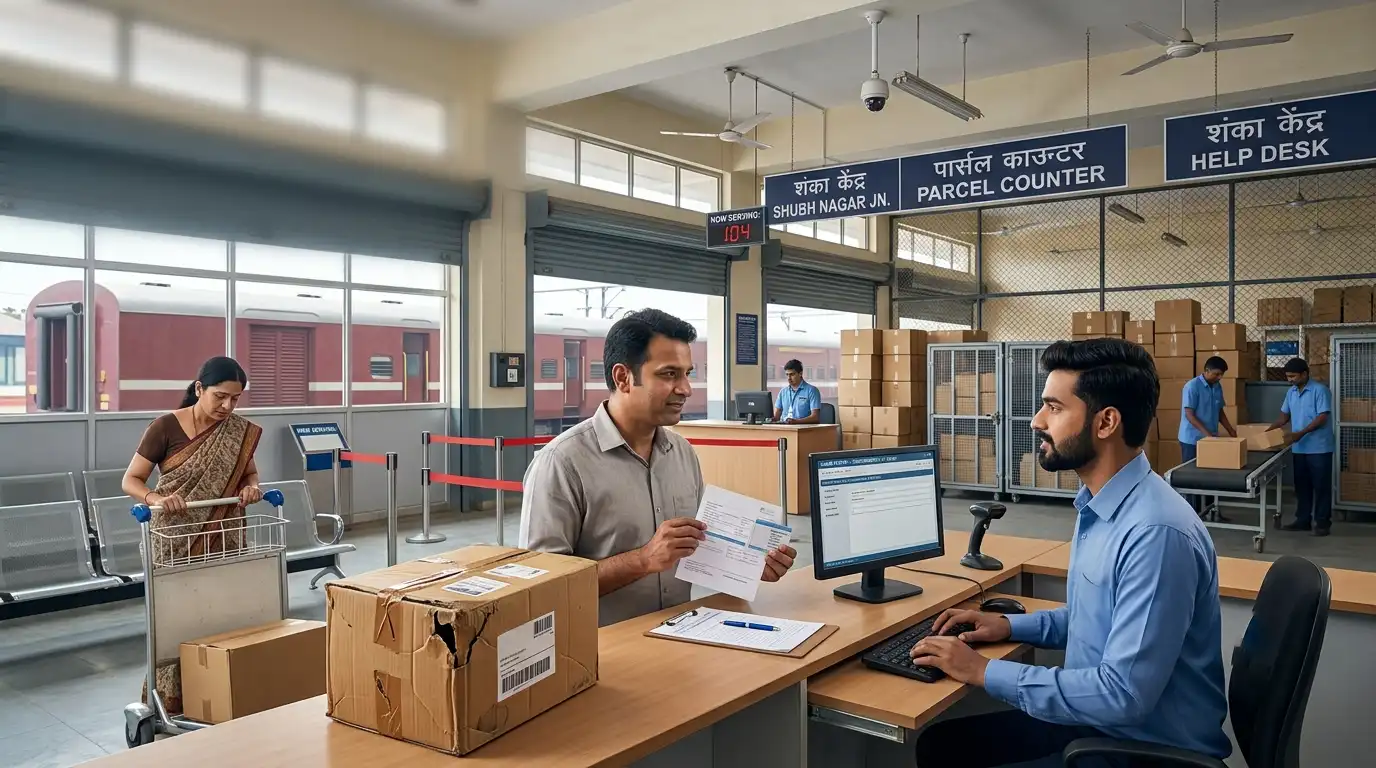
Railway Goods, Parcel and Luggage Claims: How to Get Compensation
If a consignment you sent by railway arrives damaged, short, or never arrives at all, you can claim compensation from the railway administration. You can also claim a refund where freight was overcharged. This guide explains the time limit that governs every claim, how to register online, what documents you need, how to track your case, and what to do if the claim is rejected.
The most important rule: act within six months. Under Section 106 of the Railways Act, 1989, notice of your claim must reach the railway administration within six months from the date the consignment was entrusted for carriage. A claim filed after that window is generally time-barred, no matter how genuine the loss. So register your claim as soon as you discover the problem rather than waiting for correspondence to run its course.
What You Can Claim For
| Type of claim | When it applies |
|---|---|
| Compensation claim | Loss, destruction, damage, deterioration, shortage or non-delivery of goods, parcel or luggage |
| Goods refund claim | Refund of freight, for example where freight was charged incorrectly |
| Overcharge claim | Where you were charged more than the correct rate |
| Demurrage and wharfage waiver | Where detention or storage charges were levied and you seek waiver or refund |
Before You File: Get Your Paperwork Right
A claim stands or falls on documentation, so gather these before you start:
- The original Railway Receipt (RR) or Parcel Way Bill (PWB), which is the primary proof of booking.
- The invoice or proof of value of the consignment.
- Any certificate issued by railway staff at delivery recording damage, shortage or non-delivery. Insist on this at the time of taking delivery, because obtaining it later is far harder.
- Your booking details: consignment number, booking and destination stations, and dates.
- Photographs of damaged packaging or contents, taken before you move the consignment away.
At the delivery counter: If a consignment looks damaged or short, say so before you sign for it and ask staff to record the condition in writing. Taking clean delivery and complaining afterwards weakens your position considerably.
How Compensation Is Worked Out
The amount payable depends on whether you declared the value of the consignment at booking and paid the applicable percentage charge for it.
- Where you declared the value and paid the prescribed charge, compensation is assessed against that declared value.
- Where you did not declare a value, railway liability is limited to a prescribed amount calculated by weight, which is usually well below what the goods are actually worth.
This is why declaring the correct value at booking matters so much for anything valuable. Compensation is assessed on proven loss, not on what you hoped the goods would fetch, and the rates prescribed under the rules are revised from time to time, so confirm the current position when you file.
Register Your Claim Online
Indian Railways operates a claims portal where you can register a case and track it afterwards.
| What you want to do | Where to go |
|---|---|
| Register a compensation claim, for damage, shortage, loss or non-delivery | Compensation claim registration |
| Register a goods refund claim, for refund of freight | Goods refund registration |
| Check a compensation claim status | Compensation claim status |
| Check a goods refund claim status | Goods refund status |
| Check a demurrage or wharfage waiver case | Demurrage and wharfage status |
| Check a complaint lodged in the NR Cell | NR Cell complaint status |
| Search a Railway Claims Tribunal case | RCT case search |
Keep the claim number the portal issues, since every later enquiry depends on it.
Filing Offline
You can also submit a claim in writing to the Chief Claims Officer of the zonal railway concerned, or through the station where the consignment was booked or delivered. Prescribed application forms for compensation claims, freight refunds and overcharge sheets are available from the railway office and on official railway websites. Send your application by a method that gives you proof of dispatch, because the six month window is calculated on when notice reaches the administration.
A Word of Caution on False Claims
The Railways Act treats inflated or fabricated claims seriously. Under Section 149, making a claim for compensation that you know or believe to be false is a punishable offence, carrying imprisonment of up to three years, a fine, or both. Claim for what you actually lost, and keep your documentation honest.
If Your Claim Is Rejected or Ignored
Railways does not accept every claim, and disputes are common. Your options are:
- Ask for the reasons in writing and check whether the rejection turns on a documentation gap you can fill.
- Escalate within the zonal railway, to the Chief Claims Officer if you have not already dealt with that office.
- Approach the Railway Claims Tribunal (RCT), the statutory forum set up specifically to decide railway compensation disputes. It has benches across the country, and you can search existing cases through the link above.
- Consider a consumer forum for service deficiency, depending on the nature of your grievance.
Keep every document and receipt, because the tribunal decides on evidence and the booking papers carry most of the weight.
Frequently Asked Questions
How long do I have to file a railway claim?
Six months from the date the consignment was entrusted for carriage, under Section 106 of the Railways Act, 1989. Later claims are generally time-barred.
How do I register a claim online?
Through the Indian Railways claims portal, choosing compensation claim registration for loss or damage, or goods refund registration for a freight refund. Note the claim number issued.
What documents do I need?
The original RR or PWB, proof of value, any certificate from railway staff recording damage or shortage, and your booking details.
How much compensation will I get?
It depends on whether you declared the value at booking. Undeclared consignments attract a limited liability calculated by weight, which is usually far below the actual worth of the goods.
What if my claim is rejected?
Ask for written reasons, escalate to the Chief Claims Officer, and if the dispute stands, approach the Railway Claims Tribunal.
Can I claim for a delayed parcel?
Claims cover loss, destruction, damage, deterioration and non-delivery. For delay alone, raise a grievance through Rail Madad or with the parcel office, and check whether the consignment has in fact been misrouted rather than merely late.
Quick Summary
| Time limit | Six months from entrustment, Section 106, Railways Act 1989 |
| Claim types | Compensation, freight refund, overcharge, demurrage and wharfage waiver |
| Key document | Original RR or PWB |
| At delivery | Get damage or shortage recorded in writing before signing |
| Compensation basis | Declared value, or a limited prescribed amount if undeclared |
| False claims | Punishable under Section 149 |
| If rejected | Railway Claims Tribunal |
Railway claims are winnable, but they reward speed and paperwork. Record the problem at delivery, register within the six month window, and keep every document. For related reading, see our guides on railway parcel rates and booking, sending a bike by train, and railway helpline numbers.
Have you filed a railway claim? Tell us how it went in the comments, since readers often ask how long the process takes.