

Shatabdi Express: Routes, Classes and Vande Bharat Comparison
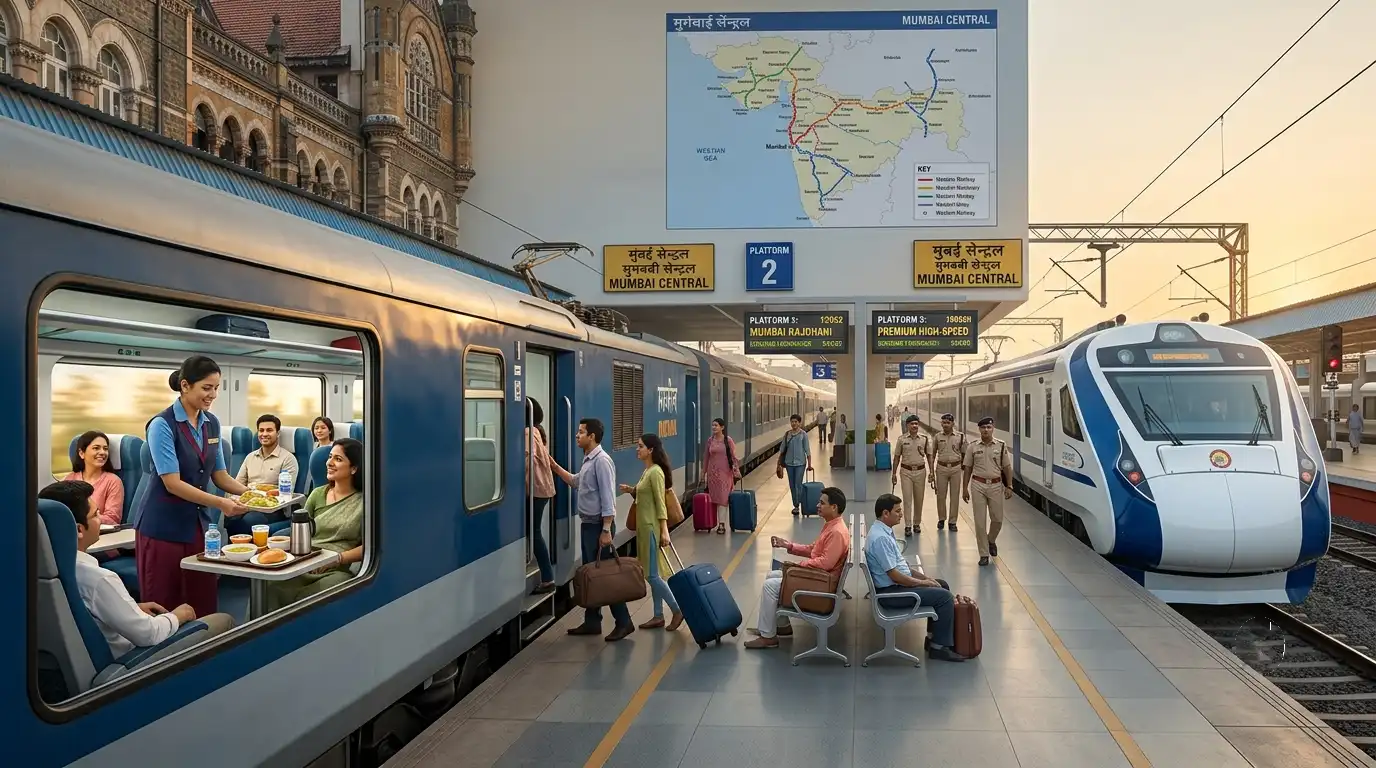
The Shatabdi Express is Indian Railways’ long-standing daytime intercity service, connecting major cities with business, tourism and pilgrimage destinations and returning to its origin the same day. Fully air-conditioned, seat-only and with meals included in the fare, it set the standard for fast day travel in India for more than three decades. This guide covers what the service offers, the main routes, the classes available, and how it now sits alongside Vande Bharat.
What Makes a Shatabdi Different
- Day train, same-day return. The rake goes out and comes back on the same day, so there are no sleeping berths.
- Seats only. Accommodation is chair car, not berths, which is the fundamental difference from Rajdhani and Duronto services.
- Fully air-conditioned throughout, with no unreserved coaches at all.
- Meals included in the fare, served according to the time of day, along with bottled water and tea or coffee.
- Few stops, which is what keeps the journey time down.
- Priority platforms at most stations, usually those closest to the station building.
Origin of the Name
The first Shatabdi Express ran in 1988, between New Delhi and Jhansi. The name comes from the Hindi word Shatabdi, meaning century, chosen to mark the birth centenary of Pandit Jawaharlal Nehru, India’s first Prime Minister, who was born in 1889.
Classes of Travel
| Class | Code | What you get |
|---|---|---|
| AC Chair Car | CC | Standard air-conditioned seating, the main class on every Shatabdi |
| Executive Chair Car | EC | Wider seats, more legroom, better catering, usually one or two coaches per train |
| Anubhuti | EA | Premium coach with upgraded interiors and seating, attached to selected services |
Every seat must be reserved in advance. Some Shatabdi services also offer current booking, where remaining seats are sold in the couple of hours before departure. For how that works, see our ticket booking and enquiry guide.
Speed
Shatabdi services generally run up to 130 kmph, with the Bhopal Shatabdi permitted a higher maximum on the stretch it shares with the Delhi to Agra high-speed section. Actual journey speeds depend on the route, the number of halts and track conditions, so a train’s average is always well below its permitted maximum.
Main Shatabdi Routes
Shatabdi services run across most of the country. Major corridors include:
| Region | Routes |
|---|---|
| From New Delhi | Bhopal (Rani Kamlapati), Lucknow, Kalka, Amritsar, Ajmer, Dehradun, Chandigarh, Kanpur, Ludhiana, Kathgodam, Firozpur, Moga |
| South India | Chennai to Mysuru, Chennai to Bengaluru, Chennai to Coimbatore |
| West India | Mumbai to Ahmedabad, Pune to Secunderabad, Jaipur to Agra |
| East India | Howrah to Ranchi, Howrah to New Jalpaiguri, Howrah to Puri |
| Northeast | Guwahati to Dibrugarh, Guwahati to Naharlagun |
Check before you plan: Timings, halts and even the existence of individual services change from time to time, and several classic Shatabdi corridors now also carry Vande Bharat services. Confirm your train’s current schedule on the National Train Enquiry System or on IRCTC rather than relying on any published timetable.
Shatabdi vs Vande Bharat: Which Should You Book?
The most significant change to daytime intercity travel in recent years is Vande Bharat Express, which occupies exactly the niche Shatabdi created: fast, air-conditioned, seat-only, same-day return. On many corridors the two now run alongside each other, so the choice is a real one.
The Key Technical Difference
A Shatabdi is a locomotive hauling a rake of coaches. A Vande Bharat is a self-propelled trainset, with motors distributed under several coaches rather than concentrated in an engine at the front.
That distinction matters more than the headline speed figures suggest. Both are generally limited to similar maximum speeds on most Indian track, so the advantage does not come from a higher top speed. It comes from acceleration. A distributed-traction trainset picks up speed far more quickly after a halt or a speed restriction, and Indian routes are full of both. Over a few hundred kilometres, that adds up to a genuinely shorter journey even when the two trains share the same permitted maximum.
Side by Side
| Facility | Shatabdi Express | Vande Bharat Express |
|---|---|---|
| Configuration | Locomotive plus coaches | Self-propelled trainset, no separate engine |
| Acceleration | Standard | Noticeably quicker, which shortens journey time |
| Classes | AC Chair Car, Executive Chair Car, Anubhuti on some services | AC Chair Car and Executive Chair Car |
| Meals | Included in the fare | Optional on most services, charged separately |
| Fare | Generally lower | Generally higher on the same route |
| Doors | Manual | Automatic, opening only when the train has stopped |
| Executive seating | Wider seats with extra legroom | Rotating seats that can face the direction of travel |
| Onboard systems | Standard announcements | GPS passenger information displays, CCTV, bio-vacuum toilets |
| Network reach | Long-established across most regions | Expanding rapidly, though not yet on every Shatabdi corridor |
Choose Shatabdi If
- You want meals included without a separate booking or payment step.
- You are travelling on a budget, since the fare is usually lower on the same route.
- Your route has no Vande Bharat service yet, which is still true of many corridors.
- You want an Anubhuti coach, available on selected Shatabdi services and not on Vande Bharat.
- The Shatabdi departure time suits your day better, which often matters more than the train type.
Choose Vande Bharat If
- Journey time matters most, since it is usually the faster option on a shared corridor.
- You want the newer interiors, automatic doors and onboard information systems.
- You are booking Executive Chair Car and value the rotating seats.
- You prefer to choose your own catering rather than pay for meals within the fare.
A practical point on fares: Because Shatabdi includes catering and Vande Bharat usually does not, the fare gap narrows once you add a meal to the Vande Bharat booking. Compare the two on a like-for-like basis before deciding that one is clearly cheaper.
What Happens to Shatabdi Now?
Vande Bharat has taken over or been added to several corridors that Shatabdi services pioneered, and more are added as new rakes enter service. That said, Shatabdi continues to run widely, and on many routes it remains the only fast day option. Rather than one replacing the other outright, the two currently coexist, with Vande Bharat concentrated on the busiest corridors. Check what actually runs on your route before assuming either is available.
For the full picture on the newer service, see our Vande Bharat Express guide.
Jan Shatabdi Express
Jan Shatabdi is the more affordable version of the same idea, introduced to bring fast day travel within reach of more passengers. It offers AC Chair Car alongside Second Class seating, and on some services unreserved accommodation, at fares well below a full Shatabdi. The trade-off is a more basic experience, and catering is not included in the same way.
Frequently Asked Questions
What type of train is Shatabdi ?
It is a Chair Car Train.
What does Shatabdi mean?
Century, in Hindi. The name marks the birth centenary of Jawaharlal Nehru.
Does a Shatabdi have sleeping berths?
No. It is a daytime chair car service that returns to its origin the same day, so it has seats rather than berths.
Is food included in the Shatabdi fare?
Yes. Meals appropriate to the time of travel, along with water and tea or coffee, are included in the ticket price.
What classes does a Shatabdi have?
AC Chair Car (CC) and Executive Chair Car (EC), with Anubhuti (EA) coaches on selected services.
What is the difference between Shatabdi and Jan Shatabdi?
Jan Shatabdi is the economy version, offering Second Class seating alongside AC Chair Car at considerably lower fares. Shatabdi is fully air-conditioned with meals included.
Is Vande Bharat replacing Shatabdi?
Vande Bharat now runs on many corridors that Shatabdi services pioneered, sometimes alongside them and sometimes in place of them. Both continue to operate across the network, so check what runs on your specific route.
Can I get an unreserved ticket on a Shatabdi?
No. Every seat must be reserved. Some services release remaining seats through current booking shortly before departure.
Which is better, Shatabdi or Vande Bharat?
Vande Bharat is usually faster and more modern, while Shatabdi is usually cheaper and includes meals in the fare. On a shared route, choose Vande Bharat for speed and Shatabdi for value, and remember the fare gap narrows once you add catering to a Vande Bharat booking.
Why is Vande Bharat faster if the top speed is similar?
Because it is a self-propelled trainset with motors under several coaches, it accelerates much faster after halts and speed restrictions. On Indian routes, which have plenty of both, that saves more time than a higher maximum speed would.
Quick Summary
| Introduced | 1988, first service New Delhi to Jhansi |
| Name means | Century, for Nehru’s birth centenary |
| Type | Daytime chair car, same-day return |
| Classes | CC, EC, and Anubhuti on some services |
| Speed | Generally up to 130 kmph |
| Meals | Included in the fare |
| Unreserved travel | Not available |
The Shatabdi Express remains one of the most comfortable ways to cover a few hundred kilometres in a day, with a seat, a meal and a punctual arrival built into the price. Check whether your route also has a Vande Bharat before booking, since the choice often comes down to speed against cost. For more, see our guides on the Rajdhani Express, the Vande Bharat Express, and live train running status.
Which Shatabdi route do you travel? Tell us in the comments how it compares with the Vande Bharat on the same corridor.